Oikeiôsis

Oikeiôsis is the Ancient Greek word meaning belonging. The concept of the human need to feel belonging was first theorized by the Stoic Zeno of Citium. To the Stoics Community was everything. Buddhism uses the term Sangha which roughly translates as the “group” or “community” of practicing Buddhists.

Community is also important to us. As social beings we all need to belong to a community where we can contribute and be valued. No one really lives in isolation by choice. To be part of the group is in our make up as a species. We need each other to survive and to flourish and from that need civilization emerged, grew and persists.


One World

The importance of community in the recovery movement is expressed through the pillars of fellowship, unity and service. People come together to share and to learn from one another. By helping others we help ourselves in the process. We understand that sitting alone at home may work for some people some of the time but true progress is made when we join with others in a common purpose. Through others we come to learn that we are not unique but share common problems, hopes and fears. We begin to realize that it is our similarities that bind us together and our diversity of thought and opinion that makes the community resilient. From that we find the strength to recover.

To be Jedi is also to be part of a community. Jedi are active participants in society. They are neither cloistered Monks nor Hermits seeking perpetual solitude. At times we all seek solitude and time away from others to recharge. Once ready we are ready to take our place among others and participate, share, learn, work and contribute in our own way. This is in our nature as human beings.


Disconnected

Sometimes it is easy to get pessimistic about the world around us. Society can seem hostile or indifferent. People often feel disconnected and alone in the world. A person may have thousands of Face Book friends but no one they can lean on and trust. We can create an online persona and profile which attracts thousands if not millions of followers and admirers and still feel lonely. Some of us feel alienated in the real world and eventually in the online realm as the hostility and toxin that pervades it forces us to disconnect even further.

Many of us live in sterile suburban neighborhoods where we live behind locked doors and barely recognize the neighbors let alone know their names.  We commute in cars to work in a sea of traffic feeling disconnected from, if not frustrated with, the blank faces in the cars around us. We sit or stand on trains or in waiting rooms our eyes fixed on our phones, not speaking, not making eye contact.


Happyness

In the Netflix Documentary “Happy” (2011) we see people living in supportive communities in Calcutta and Copenhagen. Despite the enormous gap in wealth between the two cities there is an undeniable “sameness”. Both communities are close knight, supportive and non-competitive. The members of different families and generations live together communally, share responsibilities and look after each others kids. There is a strong sense of belonging and unity which is increasingly rare today in general.

These people are among the happiest alive. The normal indicators of happiness and wellbeing; gross domestic product, employment rate and housing indices do not apply to these people. The strong sense of community is what makes these people feel happy and fulfilled.


The Odd Ball

I would be the first person to admit that I am not and never was the most sociable person. Being a strong introvert means I can be quite happy standing alone at a party without engaging anyone. Acutely aware that I was a quiet and reserved type when I was younger I naturally wanted to be liked by others. Alcohol was the remedy which allowed me to be gregarious, outgoing, funny and friendly. Drunk, I became approachable and my awkwardness was replaced with a confidence and a cocksure attitude that won people over and made me friends. Over the years I kept going back to booze and never really learned how to just be myself and connect with people on a deeper level. By the time I hit forty I realized I had all the social skills of a man in his early twenties, if not his teens.


Lost Soul

Being alcoholic is to live in a delusion. To find recovery is to see the falseness for what it is. The illusion of social acceptance and community which alcohol creates becomes apparent. We think that we “fit in” but we realize that we don’t. People who we thought were friends turn out to be nothing of the sort. Our own motivations with people become clearer and we realize they were selfish and self centred. We used people and prized things.


Getting sober we realize the relationships we had with people outside of our sphere of drinking, professional and personal, was often dishonest and sometimes abusive. Along the way we have hurt and damaged those we care about. If we are honest with ourselves we realized that we lived on the fringes of community, never in it. We did not really belong. All of this had to change if we were to truly recover and take our place in society.


Place

Being in recovery and becoming sober has forced me to re-evaluate my place in society. I have come to realize how easily I could have ended up in jail, dead or in an asylum had I continued. In recovery we learn to re-enter the community and find our place and purpose. The attitude of entitlement and “special treatment” that we used to demand in abuse is gone. We realize that in life we must earn our place and make our way without expecting dispensation because we are somehow “special”.


The community is about the whole not the individual. By being part of that whole and contributing in some small way we start to feel belonging in a real sense.


Find your Place

Most of us are not in a position to move in to a commune or co-housing arrangement where strong community is fostered as in “Happy”. There are still a number of ways we can improve our connection with others and feel part of our broader community:


  1. Embrace your identity and what makes you unique.  Also look for the common humanity in all people. Very often we find our community is divided along ethnic, religious, racial, nationalist or social class lines. We flock to those we most identify with, those with whom we resemble and share the most in common with. There is nothing wrong with identifying with a group or ideology but we must be careful not to shut out others simply because they seem “different”. This enforces the identity mindset, victim-hood mentality and “us and them” culture which pervades society today.   We have more in common than we think.
  2. Be kind and compassionate; this extends from the previous point. We should respect and treat all people the same. Humans respond well to kindness and compassion, it is a universal language common to all. Donating to local charities and supporting local businesses is one small way we can express care for others.
  3. Be prepared to help. Offering our time and skills as volunteers brings us closer to the community. You may find a particular cause or charity which appeals to you. Organisations that deal in disaster relief and emergency aid will register people who can assist in times of crisis. Even just being willing to respond to a request for assistance, where safe, is being Jedi. Those in recovery know the benefits of being of service to others.
  4. Get active in issues that concern you; whether it is a social justice cause, the environment or a local issue such as better public amenities and services there are many ways to get active. People can organise petitions, attend public meetings, form online groups, write letters, submit public comments on projects and proposals and participate in rallies and protests. Even just participating in public surveys and voting is getting involved.
  5. Join community groups; sporting and recreational, social and cultural clubs. Finding and meeting with common minded people who enjoy similar interests builds a strong sense of community.


The Circle

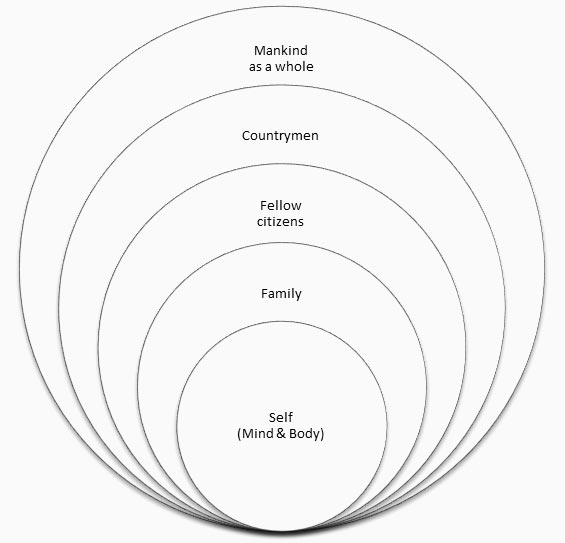
Stoic philosophy challenges people to consider themselves not only members of their community and country but citizens of the world and cosmos. The “View from Above” exercise is used to remind us that we are part of a whole which extends far beyond ourselves and our immediate circle. The Circle of Hierocles was drawn more than 2500 years ago to depict cosmopolitanism. The ancient Stoics word for “belonging” to community was oikeiôsis. The ancients saw themselves as belonging not only to themselves but in expanding concentric circles, their family, city state, country, the world and cosmos.


The Circle of Hierocles  (Source: https://howtobeastoic.wordpress.com )


We should take the time to broaden our perspective as human beings. Every action and choice that we make has a broader consequence and reach than we imagine. By understanding our place in society and our role in the community we can live more mindfully and in accordance with our nature.  We become connected with the whole.

A View from Above Meditation by Donald Robertson


Right Effort


A Jedi must have the deepest commitment, the most serious mind.” – Yoda


Ten months ago I started Daily Jedi as a personal endeavor to progress in my training as a Jedi and to fortify my 12 Step Practice. I never imagined it would require as much effort as it has. It would be easier not to bother and use the time for something else. But where would the fun be? More importantly what would I lose? Without effort and application in action everything that came before leads to nothing. In order to be the change we must do the work. For the work to be effective there must be Right Effort.

Since I started down the Jedi and 12 Step Paths I have become acutely aware that without effort there can be no gains. We can read all the books we like, become informed and educated and have the desire and commitment to change. That only gets us so far. We can make the decision to move forward and put our plan in to action.


Faith without works is dead” – James 2:26


The Path on the Path

Right Effort is the sixth step in the Buddhist eight-fold path. Right Effort supports the practitioner through every step of the Path. Any serious practitioner of meditation will tell you that meditation takes concerted effort. Meditation is not idly sitting in the lotus position. The mind is ill disciplined and prone to constant interruption by thoughts and images that intrude. A practitioner must apply effort to ensure concentration and focus in applied. Discipline prevents the practitioner from being drawn in to reverie or falling asleep. Thoughts are allowed to pass through like clouds moving with the wind without attaching to them. There is a reason why most people falter in their meditation practice; it is not easy and it requires a lot of effort even though the ultimate goal is effortlessness and realization of the state of “nothingness”.

The one on the path to enlightenment knows that if Right Effort can be applied in meditation it can be applied everywhere else where virtue needs to be cultivated and faults of character discarded.


Effort is crucial in the beginning for generating a strong will.” – Dalai Lama


Starts with You

So it is with every aspect of our lives. In order to succeed in our personal and professional lives we must be willing to put the work in to achieving desired outcomes. Effort must be applied if we want our relationships to work. Our studies and careers will falter unless we dedicate ourselves with effort. We cannot expect to make gains in our physical fitness if we do not put in the hard hours on the track, the pool or in the gym.

Our preference can be to let things slide or procrastinate until our mood and fancy take us. We may not be trying to achieve enlightenment but we all want to be better. Being better takes effort.  The change starts with you and so does the effort.

There is no definitive guide that tells us how hard we should work at what we want to achieve. We can have the support, encouragement and guidance of coaches and mentors as well as friends and family on the sideline but ultimately it is up to ourselves to decide to put the effort in and how much. No one else can or should do the work for us.

As an example, it is my choice to abstain from drinking and follow the principles I have learned on this journey. I can access the help of the sober community and a sponsor, I can read books and practice virtues every day but in the end I do the work, no one else.  Each of us must ultimately decide how much effort to apply in our own lives. Others can show us the way but we do the work.


Moderate effort over a long period of time is important, no matter what you are trying to do. One brings failure on oneself by working extremely hard at the beginning, attempting to do too much, and then giving it all up after a short time.” – Dalai Lama


The Middle Way

We live in a world where many are choosing the easy path. For most there is no choosing the hard road which Roosevelt called “the Arena”. That way is rife with great risk, danger, hard work, self sacrifice and extraordinary effort. Very few choose to take that path but you will meet them usually serving others often to the sacrifice of their own lives. Those that choose what Buddha called the “Middle Way” of the Eight Fold Path see the benefits of effort without the hard way of self mortification or the easy path of self indulgence.

The Middle path requires discipline, commitment and a life time of effort to succeed. In our world today even that is too much for most people. They prefer the “Easy Way” which requires little effort for great return. People want something for nothing. Entitlement, free pass, medals for passive participation and mediocrity have become the standard of the day.

Mediocre effort produces mediocre results. Moderate effort over a long period brings tangible results.


Seek Balance but Do It

How should we achieve the “Middle Way” of effort? The secret is in balance and prioritizing. At the beginning of my recovery I was like a Zealot that devoted every waking hour to my practice. I became fanatical and a religious bore. With time I settled down and realized that I needed to relax and take it easy. I began to find balance in my life again and let my guard ease a little.

The unreasonable goal of perfection was replaced with reasonable progress over time. There were some cardinal rules, for example I chose to abide to my core values and principles, perform my daily practices, eat healthy, exercise, meditate and refuse alcohol. I still follow this regime. The fanatical zeal in which I strove to follow the path has been abandoned for something more temperate and spiritual; a “Middle Path”.

We don’t need to break records (or our neck) in our efforts. Which just get up in the morning and do the work. But we do it easy and with purpose.


Surround yourself with people who take their work seriously, but not themselves, those who work hard and play hard.” – General Colin Powell


Jedi Way

Consider the fictional Jedi. Obi-wan Kenobi and Yoda were never so intense and driven in the execution of their duties that they lost their way to destructive emotions like anger and frustration. The Jedi sought balance and harmony in all things. This meant that work was performed to a high standard but a Jedi also took time out to rest and recuperate between missions. If a mission could not be accomplished they learned from the failure and moved on. The Jedi could be playful and engage in fun but were also studious and serious in their studies and training. In my view the Jedi followed a “Middle Path”.

The Zen teacher Thich Nhat Hanh taught that Right Effort is meant to bring joy and interest not misery and exhaustion. The Jedi exemplified this. The Sith, in contrast, were more absolute and fanatical in their approach which bent them to the Dark Side of pain, suffering and self mortification. Suffering they also had a desire to inflict pain on others.  Choose the Middle Way and surround yourself with those that do as well and you will succeed.


The idea of Right Effort is to replace negative emotions with positive ones” – Larry Shapiro


Philosophy is Action

Philosophy aims for inner change which will over time be reflected in our external reality. When we talk about Right Effort it is not just training harder or greater application in meditation or any other endeavor it is about applying effort to making inner change.

Some of us find it hard to avoid getting angry, frustrated or resentful when things don’t go our way. We can lose patience with people who do not meet our expectations or have not reached our level of maturity. Despite our best intentions we can slip back in to bad habits and allow ourselves fall in to self indulgences which we later regret. In order to change we must be willing to be “on our game” and apply effort in which ever area we wish to change. We want to adopt virtues that are useful and discard unwholesome habits.

Change may require us to “fake it before we make it” for a while but by “acting out” to the best of our ability at least we are applying Effort. We will make mistakes and fall short many times but the important thing is we get back up and keep going. Eventually we become the change we seek.

Why else would we be interested in philosophy if our goal was not to use it to change for the better? For action? Why would we want to do something if it took no effort? Philosophy is of no use unless it drives effort and is translated in to real action through work.

Take action, do the work and harvest the rewards.


“It is not the critic who counts; not the man who points out how the strong man stumbles, or where the doer of deeds could have done them better. The credit belongs to the man who is actually in the arena, whose face is marred by dust and sweat and blood; who strives valiantly; who errs, who comes short again and again, because there is no effort without error and shortcoming; but who does actually strive to do the deeds; who knows great enthusiasms, the great devotions; who spends himself in a worthy cause; who at the best knows in the end the triumph of high achievement, and who at the worst, if he fails, at least fails while daring greatly, so that his place shall never be with those cold and timid souls who neither know victory nor defeat.” – Theodore Roosevelt

Intention

A Jedi uses the Force for knowledge and defense, never for attack.” – Yoda


Symbols of Intent

The first thing most people imagine when they hear the word Jedi is Luke Skywalker or Obi-wan Kenobi with Light Saber in hand rushing towards an enemy as they deflect laser bolts. The image of the warrior is prominent in peoples mind. It is true that the fictional Jedi are armed with light Saber the same way Monks of the east and west were armed with staffs and martial arts to defend themselves. To imagine the Light Saber as a weapon of offense is an error in fact it was a symbol of the Jedi principle of protection and defense. The intent of the Light Saber is its power. It was only used as a weapon as a last resort and never in anger.

In “Return of the Jedi” Luke casts aside his Light Saber during the final confrontation with Darth Vader. The act is symbolic. Luke decided to cast his anger aside and find the love and compassion within him. It is the only way he can defeat Darth Sidious and redeem Vader.

In “The Last Jedi” the ageing Luke Skywalker takes the Light Saber offered to him by Rey after she has found him living as a Hermit on the hidden planet of Ahch-To. With comical irreverence Luke throws his old Light Saber behind his back.

For years Obi-wan Kenobi resided on Tatooine watching over Luke from a distance. Although he still had his Light Saber it was kept aside. Even in confronting the Sand People who had captured Luke Skywalker in “A New Hope”, Obi-wan Kenobi chose only to use the power of perception and his own voice in driving the Tuscan Raiders away in fear. The Light Saber is symbolic of the Jedi only if it used with Right Intent.


Lethal Intent

I’ve often heard the statement that firearms kill people. A gun can be used to kill a person however it is not the weapon itself that decides its end use. The intent to kill resides with the wielder. A sword can just as easily be beaten in to a plow than used as a weapon depending on the intention of the user.

Intention is therefore everything in the “why and how” we conduct our life. I can choose to own a Light Saber, a Gun or a Pit Bull Terrier.  The Light Saber replica won’t have much use but how I choose to manifest my intent with a gun and an “aggressive” breed of dog is entirely up to me. I can keep the gun locked away and hopefully never ever have to use it and I can train the Dog to be a loving pet; gentle with people and other animals. There is still an element of uncertainty based on what I have control over and what I don’t. The Dog may unexpectedly bite a child and the gun might be stolen and used in a crime.


Reasoned Intent

With every decision we make there is always an intent, a purpose. Why do we make the choices that we do? What is our intent? When I left High School and presented to an Army recruiter the first thing he asked me was “Why do you want to join the Army”? He said my response was important and it had to be honest. The answer revealed my true intention and whether I was going to stick my contract or wash out.

Likewise when I first approached the Jedi community and revealed I wanted to train in Jedi philosophy I was asked to spend some time thinking about “Why Jedi”. What was the intent of my choice? Would it sustain my practice past a few weeks or months? Did I realize it was an internal path and one I would have to keep largely to myself? I found that being able to reason rather than rationalize my intent before doing something was more likely to align it to who I am and want to be.


First things First

One of the most important questions I had to ask myself when I was drinking to excess was “Why am I doing this? What is the purpose?” There was no reasoned or even rationalized response. In the beginning the intent of my drinking had been to feel better within my self, to fill some emptiness inside. I wanted to be accepted and loved like everyone else and drinking seemed to promise a way into fellowship, confidence and acceptance.

Drinking could make me feel part of something bigger than myself and to be somebody who could be respected, admired and sought out. Of course this was all a mirage and I fell in to the trap and it took me to a dark place after all the illusions I had created began to fall away.  Something entirely different was revealed. An image that was unbearable to confront.

In the end, the intent of drinking was to satiate a need that could not be satisfied and to keep the beast within fed. It had become a cage. Realizing true intent was like lifting the veil that had shrouded the truth for years. I began to understand the true nature of my disease.


Failed Intent

All the times I had tried to quit or at least control my drinking in the past had eventually ended in relapse. In going on the “wagon” I had had good intentions but I could not follow it up with meaningful actions. My intent was also conditional on certain loop holes in thinking. Like small cracks in a dyke they eventually split open and allowed the entire structure to collapse in a flood of booze. Intention was moderated by rationalization. I figured I could still achieve my goal of sobriety with the odd loosening of the belt. This of course was a form of “False Intent”.


A Daily Reprieve

Where do your priorities lay? What is important to you? What matters most of all? In the beginning my intent was to simply get through the day without taking a drink. The next day could look after itself and the next day after that. My commitment was for 24 hours.

I would renew my intent every morning and claim the strength from my Higher Power to achieve that. At the end of the day I would review how things had gone and on turning off the light thank my Higher Power for another sober day. My goal was sustained and long-term sobriety and my dream was to realize serenity.

My intent was simply to claim a daily reprieve and stay sober one day at a time through application of certain virtues and principles. This was a form of “Right Intent”.


What we really have is a daily reprieve contingent on the maintenance of our spiritual condition” – Alcoholics Anonymous p85.


Right Intent

The second step and virtue on the Eight fold path of Buddhism is “Right Intent”. Intention is more than resolve. Through resolve we decide to do something but it is not enough on its own. We must have “Right Intent” in order to stay the course. For example would anyone who resolves to marry another person bother if they did not intend to give the marriage their utmost for as long as possible?

Resolve and Intent are two different things and of course they work in tandem. Both must stay as strong as the day we set off for the duration of the journey. Yes there are days when we stagger and fall but intent keeps us moving forward even when resolve falters. We strive for outcomes but must also accept what is in our control as well as what is outside of it.

Intent in Action

Intention is flawed if our intent is;

  • To draw something to ourselves for selfish gain; or
  • to force something away through ill will;
  • or to do harm to ourselves or others.

To counteract flawed intention one’s intention must;

  • Be based on renunciation. We must be willing to let go of the causes of our suffering. Desires and clinging attachments to people, places, things, circumstance and flawed ideas tightly held all lead to suffering as they are impermanent and transient. Addiction is a form of rampant attachment. Luke Skywalker casting his Light Saber aside was a renunciation of attachment to old strongly held beliefs.
  • derived from good will. When we do things we essentially seek to serve others before ourselves. In the recovery program personal benefit is derived by helping others struggling with their addictions. Caring for others is a corner stone of Faith and many philosophies including Jedi Philosophy.
  • inherently harmless. In the 12 Steps amends are sought to people whom we have harmed wherever possible, except when to do so would injure them or others. The Hippocratic Oath compels Doctors to “primum non nocere”, first do no harm. Compassion is a Jedi trait.

Right intent is expressed through thought, word and actions. Therefore being mindful of intention is important. We should consider the impact of our thoughts, words and actions on self and others.  The potential consequences either immediate or delayed should be considered. We may do something with the best of intentions but not realize the consequences of our actions until much later. By contemplating our actions and looking beyond outward far beyond ourselves we become more mindful of the reach of our intent.

Always ask what your intent is and whether it serves or not.


The Jedi Method

The Jedi Method is a formula used to apply mindfulness in our actions. Our desire is for an outcome which aligns with our values. The method states:


Intent + Action = Outcome


If our Intent is right and our actions follow suit than there is a high likelihood, while never guaranteed, that outcome will agree with action and intent. Action and Intent is applied in a world in which we do not exercise supreme control over all external factors. We cannot foresee the future or account for every single possible variable. We only have what we control (Intent and Action).

  1. Ask yourself before committing to an action “Could this action lead to suffering?” If the answer is “yes” reconsider it after applying ethics and your personal value system to a decision.
  2. During the action ask “Is this action causing suffering?” if so, then reconsider the need to continue or make adjustments that correct the error.
  3. After the action consider “Will this action lead to suffering?” if so, then seek to remedy, learn from it and avoid repetition in the future.

We live in an imperfect system and everyone makes mistakes. All that one can reasonably expect is that we take due diligence in our actions. We are accountable and responsible for the choices we make. If our intent is challenged we can defend our actions with conviction and without hesitation.

We take charge of the things that we can control, work with what we can influence  and we willingly surrender the things over which we have no control.


Surrender at Last

A Light Saber can be a weapon or a door stop depending on the intent of the user. Perhaps Luke Skywalker had learned towards the end of his physical existence that the mind is far more powerful than a weapon. The Last Jedi decided he no longer needed his Light Saber even for the purpose of protection.

On the Planet of Crait Skywalker faced his old apprentice and nephew, Kylo Ren, who was bent on killing him. Luke showed that one can still achieve an outcome without reaching for a Light Saber or without even being there. Victory can be won with the mind.

Across the Galaxy on the Island Jedi Refuge of Ahch-To, Luke Skywalker awoke from his Force projection and surrendered himself to the Force. As he met his destiny the twin suns set over the ocean.

Intent is the key.

Our Intention creates our reality” – Wayne Dyer

Carrie

WARNING: This article contains Spoilers to “The Last Jedi”


You know what’s funny about death? I mean other than absolutely nothing at all? You’d think we could remember finding out we weren’t immortal. Sometimes I see children sobbing airports and I think, “Aww. They’ve just been told.”
― Carrie Fisher, “Wishful Drinking”

Shakespearean

Star Wars has been called a classic Hero’s Journey and a Shakespearean Tragedy. The Story of Luke Skywalker in the first trilogy was based on Joseph Campbell’s a “Hero’s Journey”. Anakin’s story in the prequels was essentially a Shakespearean Tragedy.

So many people hated the prequels. I loved them. It was a tragic story with a warning. Anakin was driven to madness and eventually to the dark side. The noble Jedi Order became a shadow of its glorious and chivalrous self as it was dragged in to the final fall of the Republic and destroyed. There is revenge and murder and in the tradition of a Shakespearean Play everyone dies or is lost.

Anakin becomes Darth Vader, Padmé Amidala dies of a broken heart. Palpatine gives Order 66 and the Clone Legions massacre every Jedi they can find. The temple is destroyed and all in it are slaughtered. What is left of the Republic submits to Emperor Palpatine or flee in to exile. Some join the Rebellion. The Jedi and the Force become mere Legends.The memory of them is suppressed in the Galaxy.


New Hopes

Luke was an ordinary boy who was unexpectedly and reluctantly thrust in to the “Hero’s Journey” at the beginning of  “A New Hope”.  Obiwan “Ben” Kenobi is the mentor who initially guides Luke on the journey. Luke gains confidence and courage and the will to destroy the Death Star.

In “Empire Strikes Back”, Luke is trained further by Yoda as he stumbles along on the path always learning. Luke goes on to confront his fears and his foes throwing himself in to peril. At first Luke fails but in “Return of the Jedi”, he has become a Jedi Knight and through wisdom and love defeats the Sith Lord and redeems Darth Vader. This was Luke’s final test on his journey.

At the end of the adventure Luke has reconciled with the truth of his past and has helped restore balance to the Force. With knowledge Luke goes on to rebuild the Jedi Temple and resurrect the order.

The third trilogy breaks from this tradition. I did not know what to make of “The Force Awakens”.  The movie bought back the old characters. It was a love letter to the original fans while introducing the future of the franchise. I recently watched “The Last Jedi” and after the initial shock and confusion I realized that the movie is a Tragicomedy. If you know anything about Carrie Fisher you would agree that  the dedication of “The Last Jedi” to her was entirely appropriate. Carrie Fisher’s life was a Tragicomedy after all as was Leia Organa’s.

She wondered if she was in the midst of an anecdote that, for reasons of proximity, she was not yet able to perceive.” – Carrie Fisher, Postcards from the Edge

The Raddus

There is a scene in the Last Jedi which is pivotal to the movie. For me it is possibly one of the most compelling scenes in the entire Star Wars saga. The act comes after The Resistance, led by General Leia Organa (Carrie Fisher), has been tracked through hyperspace by a battle fleet of the First Order. The Resistance had jumped after they had mounted a successful attack destroying an enemy Dreadnought. The remnants of the Rebel Force had evacuated the base planet of D’Qar and were able to narrowly avoid being destroyed. Now after coming out of hyperspace they find themselves facing a vastly superior enemy force led by Kylo Ren.

Kylo Ren is leading a Fighter attack on the Resistance command ship Raddus but is conflicted when an opportunity arises to fire laser missiles in to the command bridge. Kylo Ren was once Ben Solo, the son of Han Solo and Leia Organa. At this moment Kylo Ren knows that his mother is on board the Raddus and he hesitates. Kylo recently killed his Father and seems unsure of himself once again. A moment later Kylo Ren’s wingmen fires on the Bridge.

The movie cuts to the bridge where General Leia and much of the commanding officers of the Resistance are present. An explosion fills the screen and we see Leia and what is left of the Bridge sucked in to the void of space. The scene is dramatic and shocking. We have just witnessed General Organa killed in the most unexpected way; blasted in to the space in a violent and final act.


Leia’s Near Death Experience

I stared in stunned disbelief at the screen and almost applauded. The scene was pure genius as devastating and heart wrenching as it was. Soon after General Leia’s body appears floating in space as a battle rages behind her. The face of Leia fills the screen and she looks serene and at peace. She is beautiful and compelling. Ice has begun to form on her face and we know she will be preserved forever like that in the void. It is a touching and heartfelt moment. Final. I knew I would carry this moment in my heart for the rest of my days. This is the way I would remember the Princess. It is a good ending to a magnificent and treasured character and a beloved actress…then something unexpected happens which is truly comical…

The slightest movement ripples across Leia’s face and she opens her eyes! My mind is utterly confused. What the hell is going on? How can anyone survive such an ordeal Force or no Force? General Leia then orientates herself and begins to fly through space back towards the gaping hole in the Bridge of the Raddus. Like some haunting scene out of Mary Poppins she floats through the destroyed remains of the Bridge to a vacuum lock. There is pandemonium on the Raddus as the crew realize what is happening and they manage to open the air lock and bring Leia on to the safety of the ship. Soon she is on a stretcher being taken to the Infirmary.


The Problem

I shook myself out of stunned disbelief as someone a few seats away guffawed loudly. There was laughter in the theater and I found myself laughing at the absurdity of the scene.  At this point the movie seemed to get worse and worse. I could no longer take it seriously and viewed the entire experience as some sort of bizarre joke.

It suddenly occurred to me that the Director Rian Johnson had created a completely unexpected Star Wars movie. No one saw this coming. He had also inadvertently blown away a chance for a serendipitous ending to Princess Leia and had kept her alive presumably for the next film. Ironically Carrie Fisher would tragically pass away soon after filming the scenes in “The Last Jedi”, exactly one year ago on 27 December, 2016. I wonder if the producers at Disney secretly kicked themselves afterwards. The death of Fisher leaves them with a plot predicament. Its almost funny an a tragicomic way.


Life is a cruel, horrible joke and I am the punch line.” – Carrie Fisher “Postcards from the Edge


Retrospection and Punch lines

Retrospection is a wonderful thing as is a good punch line. Carrie Fisher did a lot of both in real life. Some say her real career was storytelling, comedy and critiquing her own life. Despite a life filled with heart break, tragedy, drug and alcohol abuse and mental illness, Carrie Fisher never felt sorry for her self or sought out public sympathy. If anything she made light of her trials.

In her books Fisher often uses wit and humor to highlight her character flaws and lighten the tragedy around much of her life. Reading some of the hundreds of obituaries written for her I am reminded how was she was an incredibly talented and intelligent person with a sharp wit, beaming personality and a sometimes dark humor. Without a doubt she was much loved but also respected as a strong woman and a tough character who always stuck to her guns. Carrie Fisher was very much like her Princess Leia.


I think I am Princess Leia and Princess Leia is me, It’s like a Mobius striptease” – Carrie Fisher


“Wishful Drinking”

Carrie Fisher had her demons. She had been abusing drugs and alcohol since her teens. Despite her addictions, Carrie Fisher never self-destructed or wound up dead at a young age. She kept her humanity in an industry where people lose their soul and prey easily on others. It is a wonder Hollywood did not grind her down utterly. She was small in stature but had the heart of a giant.

Carrie Fisher was irreverent and extremely funny. She was described as the person you would most want to sit next to at a wedding or a funeral. Is it any wonder? Many people who have gone through the wringer of alcoholism and drug addiction find a dark but refreshing humor in recovery. We who have survived learn to laugh at ourselves most of all.

Carrie Fisher could raise a laugh in any situation. In her book “Wishful Drinking” she describes how George Lucas insisted she not wear a bra under her dress during a scene as “there is no underwear in space”. On this Carrie Fisher asserts that while bodies in space expand, bras do not, therefore one could be strangled by their own bra in outer space. Carrie goes on to say that she would like her obituary to be thus:


Now I think that this would make a fantastic obit- so I tell my younger friends that no matter how I go, I want it reported that I drowned in moonlight, strangled by my own bra.” – Carrie Fisher “Wishful Drinking”.


The Last Laugh

For that reason I find the “Mary Poppins” scene and the many faults of “The Last Jedi” almost a cheeky nod and wink to Carrie and her fans. She would have loved the comedy of it. The irreverence towards the original movies and the ridiculous plot holes which have divided the fans like no other Star Wars movie would have delighted her. Carrie Fisher would have laughed her head off if she had lived to have seen the final cut.

The “Mary Poppins” scene would have become a central piece to her comedy shows. For a start there is no way she could have been wearing a bra as she floated in space. Wearing brassiere would have certainly killed her even if she could survive in a freezing vacuum. At the very least it would have made the entire experience of Force  flying back to the Raddus extremely uncomfortable.  I wonder if the scene was Carrie Fisher’s idea for a bit of fun and whether George Lucas was in on the joke.


“From here on out, there’s just reality. I think that’s what maturity is: a stoic response to endless reality. But then, what do I know?” – Carrie Fisher “Postcards from the Edge”


Thanks for the Laughs

“The Last Jedi” closes the coffin lid on the original trilogy and passes the baton on to the next generation. The movie heralds an end to a story that has endured for 40 years. To paraphrase Carrie Fisher I feel like the child at the airport who is weeping inconsolably after being told the unthinkable; Luke, Han and Leia are all dead and the Star Wars as we knew it is no more.

I’m not sure I will ever like the movie “The Last Jedi”. Perhaps it will grow on me now that I can view it as a Tragicomedy. I can’t hate Disney or the movie, which would be un-Jedi like. Jedi do not hate after all. We can still lament George Lucas sold the rights.

Kylo Ren says in the film “It’s time to let old things die”. Luke Skywalker exclaims to a confused Rey “I know only one truth. It’s time for the Jedi to end.” As hard as it is to let go of the things we treasure and move on, we ultimately must. Change is essential and keeps things vital. Change is also inevitable.

I’m wondering if Carrie wanted to add the line “I drowned in moonlight, strangled by my own bra” in to the movie. That would’ve been her style. Rest in Peace Carrie Fisher, Princess.


No motive is pure. No one is good or bad-but a hearty mix of both. And sometimes life actually gives to you by taking away.”
― Carrie Fisher, “Wishful Drinking


The Gathering

He who faces himself, finds himself.” – The Clone Wars “The Gathering” Series 5 Episode 7

Ilum

In the Clone Wars (Series 5, Episode 7 “The Gathering” ) a group of Jedi Younglings are taken to a the planet of Ilum where they will complete a challenge called the Gathering. The Gathering is a rite of passage in the journey to becoming a Knight. The purpose of the challenge is to unite the young Jedi with the crystals that will form the heart of the light sabres they are expected to fashion on completion of the challenge. Each of the sacred Kyber crystals found within the protected Jedi caverns of Ilum amplify the Force and are tied spiritually to the essence of the Jedi it chooses to wield it. The Light Sabre becomes part of the Jedi as it contains their crystal and harnesses the energy of the Force. This is one of the reasons a personal light sabre is such an important part of a Jedi.

As the six Younglings arrived with Ahsoka Tano they are greeted by Yoda who explains the purpose of their mission. They are to enter the caves and each find the crystal which is matched to them. Yoda does not only want the young Jedi to find their crystals and fashion light sabres. The hidden purpose of The Gathering is to test each individual and push them to face and overcome their weaknesses by working as a team but ultimately each facing the ordeal alone. Like the cave on Dagobah where Luke was tested, the caves of Ilum can sense and manifest the fears and weaknesses of those that enter it. Each Jedi is being judged by his or her actions during the challenge. How they conduct themselves determines whether they pass or fail the test in the next step to becoming a Jedi Knight.

As the Youngling Jedi watched on, Yoda uses the Force to turn the ice wall in to water as the sun rises illuminating the cavernous chamber. The entrance to the Jedi cave opened Yoda warns the Younglings to use their skills and the Force to locate their Kyber Crystals. This they have to do as quickly as possible. As the sun begins to lower the ice wall will form over the entrance closing them in the cave for a full rotation of the planet. Facing their doubts and fears the Younglings enter in to the cave.


The March

Twenty of us were gathered in the early morning chill shivering in the dark. There was a hint of the sunrise on the horizon and birds had began to call in anticipation of a new day. The men around  me spoke  in hushed tones. There was a sense of anticipation, dread, fear and hope mixed with bravado. A few smoked last cigarettes and told jokes. Water was guzzled from canteens and a ration energy bar eaten hurriedly. Packs and weapons were propped up nearby having been checked and weighed by the instructors.

This was the final week of Basic Training. There had been thirty two at the start and now we were half of the original Platoon. Recruits had dropped off along the way from injury or failing tests and had been back squadded to Platoons farther back in training. A few had decided to leave the Army completely and requested to cancel their contracts and with some pulling teeth had been granted a dismissal. One had gone AWOL one night and had never returned. Three of the men in our final platoon had been back squadded from earlier platoons. One had been trying to reach graduation for almost a year.

Today was the last test of nearly six months of Basic Training. Over the last few days we had done route marches over 100km of terrain, completed physical fitness tests, completed navigation exercises, run obstacle courses and expended thousands of rounds of ammunition on the range. We had been tested on field craft, first aid, military history and tradition, weapons handling, basic infantry skills and radio communications. Today we had to speed march over 42 kilometers of trails and roads through farmland, heath and forest to a destination where we would be given our corps badges and welcomed in to the family.

We had less than 7 hours to do walk the distance carrying 40 pounds of kit and every one had to cross the finish line as a unit. It was explained that we were being assessed as a team and as individuals. We were to leave no man behind and carry or drag anyone that could not keep up or who fell aside. The pace was going to be brutal because the Officer leading the march was a fitness freak who did these just for the fun of it. Given that none of us had slept that night it was a tall order. It was emphasized, there would be no quitting.

A short safety brief done, the platoon sergeant ordered us to shoulder our packs. I groaned under the weight and cursed as I felt an item stick in to my kidney. Jumping up and down I managed to get it sitting comfortably. I knew within a few kilometers the straps of the pack and webbing would be cutting in to my shoulder stemming circulation. The pouches on my belt would rub at my hips and I’d be feeling heat sores and blisters forming on my feet and crotch. I had tapped up raw patches and was prepared physically and mentally. But I was still anxious and doubted myself.

Over the next few hours there would be nothing but the sound of feet stamping the ground and labored breathing. There would be the urging on by the instructors which would alternate between gentle pressure and frustrated yelling. I would be alone with my thoughts, my self-doubt and fears and would have to push through one pain barrier after the next. This was the final test and the key was to focus on the prize at the end. As light rose above the horizon we set off, silhouettes on the road. I settled in to the pace my eyes locked on the figure in front of me and I started to day dream.


The Crystal Hunt

During the hunt for crystals inside the Jedi Cave on Ilum, the young Jedi face their weaknesses one by one and overcome them individually but also as a group. Petro is selfish and impatient and in his haste to find a crystal almost fails the task and also abandons Katooni trapped behind in chamber behind an ice wall. It is only at the last moment that he becomes selfless and rescues Katooni. Petro then works through his task mindfully. He finds wins his crystal and frees himself from the cave. Katooni was at the beginning full of self doubt but her courage and determination sees her overcome her fears. Hesitant at first she scales a sheer rock face to claim her crystal and also finds her self confidence. When Petro abandons her she realizes her fate is sealed and accepts it with equanimity.

Meanwhile the Rodian, Ganodi is despondent in being unable to find a crystal. Her lack of Faith in the Force and her own ability leads her to search aimlessly. It is by finally being present in the moment and turning over the process to the Force that she  is able to identify her crystal and claim it. Ganodi finds Faith and allows the crystal to find her.

Zatt, a Nautolian Youngling also seeks aimlessly and is distracted by technology during his search. Rather than using his intuition he was relying solely on a device to help him find his crystal. Zatt has failed to understand that technology may help but it does not complete missions alone or win wars. His senses and intuition cannot be replaced by a computer. It is only by destroying his personal computer that Zatt is able to open himself to the Force and find his crystal. By doing so Zatt finds his inner intuition and begins to sense with his feelings, not only his thoughts.

The Wookiee Gungi soon finds his crystal in the middle of a frozen subterranean lake partially bathed in sunlight. Attempting to cross the lake Gungi almost falls through the ice. It is apparent that he must wait for the sunlight to recede off the lake allowing it to freeze solid. The Wookie is impatient by nature and forces himself to settle in to meditation and resist the urge to act. As he waits the sunlight recedes from the lake and it freezes over. At last he is able to claim his crystal. Gungi also claims patience as his prize.

Byph, the Ithorian encounters his crystal guarded in a cavern that appears to burn with some malign presence. The Ithorian is terrified of monsters and must muster all of his courage to enter the chamber and take the crystal. When he does he realizes the imagery he had encountered was nothing but the product of his own fears. It was his imagination, the irrational fear of the dark.  Failure is often the product of fear and fear is more often than not completely unjustified. The best way to overcome fear is to face it up close. The “monsters of our imagination” vanish in  to thin air if we refuse to give them power through our mind. Byph does exactly that and also finds his courage.


The Last Mile

The platoon was now moving at a canter. My reverie had long been replaced with pain and mental anguish.  Everything was burning. My lungs, legs and back begged for the pace to slow or stop. The last short rest break had been over an hour before and we were now pushing the pace to make up time. A soft rain drizzled down which was a blessing and a curse because it cooled down bodies but made everything wet and heavier. Everyone wheezed around me, coughed and spat as we labored forward. No one had fallen out yet. I knew from the road and passing country we were coming towards the end. We rounded a corner and there it was, two trucks and an ambulance about 400 meters ahead. The finish line! Hearts soared and a cheer went up from the platoon. We sped up in to a run.

We drew closer and the vehicles suddenly roared in to life and drove away disappearing in a cloud of smoke. I stared in disbelief and horror. Someone groaned and swore loudly. Everyone’s hopes were dashed. I wanted to fall to the side and collapse in to a road side drain and cry like a baby. One of the instructor yelled at us “keep Effin moving, this is it, this is why you have been working!”. Soon enough the vehicles reappeared further down the road and we ran up to them gasping for air. Our Platoon leader directed us to drop our packs and form up. We had finished and passed the test.


The Tally

In the space of 6 hours and 20 minutes  to complete the march every emotion had swept over my consciousness. I felt as if I had to grapple with every dark and negative thought that visited to keep putting one foot in front of the other. My mind tormented me constantly, egging me to quit. During moments that seemed like hours I hated myself and the men around me and wanted to be anywhere else but there. Self pity filled my senses and I wallowed in the mud of a personal misery. Someone started to falter and fell behind and the instructors fell on him like hyenas, yelling and cursing him to move it as he begged that he couldn’t go on. My heart filled with rage and hate as we were halted, did a 180 degree turn and ran back to him so he could find his place back in the pack before we turned around and resumed the march. Fantasies started to fill my mind, some pleasant and others terrifying and disturbing. My mind screamed through the pain. We were barely at the 20 kilometer mark.

As the march progressed past that half way mark and we came closer to the finish line the mental burden started to ease a bit and I started to get numb to the pain. The time we were making was encouraging and everyone was keeping up the brutal pace. As the mental fog started to lift a ray of sunshine started to filter through. I felt renewed confidence and self belief. Doubt and self pity was replaced with a sense of hope, courage and determination. “I can do this” I thought. We started to encourage each other and those that were suffering more than others. With words of encouragement came a renewed drive to push through the mental and physical barriers of the march. We were working as a cohesive team that cared for each other and wanted each other to succeed.


The Will to Succeed

All of the Younglings had made it outside of the Cave except Petro and Katooni. The four Younglings wanted to re-enter the cave but Yoda told them to not to move. There is a time to act and this was not one of them. The Younglings in the cave had to face their peril alone as Jedi often must. Katooni appeared as the ice wall was closing and manages to slip through with inches to spare. Petro was not with her. By rescuing Katooni, Petro had lost precious seconds and was now trapped behind by the ice wall. The cave entrance was sealed. The Younglings stared at the wall in realization of the loss of their friend who would certainly freeze to death in the cave. Yoda and Ahsoka did not seem concerned. A moment later, Petro smashes his way through the ice wall and presents his crystal to Yoda. The ice wall could be broken. It was only impenetrable if the mind allowed it to be.

After the March and back in Barracks, one of the Instructors said that the final march was a mental challenge more than a physical one. The march was intended to test character as much as fitness and force each recruit to face their weaknesses and overcome them. They had no doubt that after six months of training most of us were fit enough to have been able to turn around and march back to the start line if we had been ordered to do so. That was our job. In war time under horrific conditions, wounded and exhausted soldiers are force marched over far worse terrain for days, not hours.

The Sergeant revealed that Recruits did not quit because they physically could not handle training, they quit because they lost the mental game. They quit because they built walls in their minds and sabotaged themselves along the way with self defeating talk and attitudes. The vehicles had been parked a kilometer short of the finish line on purpose. They had been instructed to move on as we approached. The reason for this was simple, a person’s character is revealed when you give them hope and then snatch it away. Spirits that were soaring had now hit rock bottom. This is the moment when most will give up and quit, at the very end of the road. The Sergeant asked us all; “What were you going to do? Keeping going or lay down and die?”. The Instructors wanted to know if they were sending Lambs or Lions to a unit that could go to war.

No Limits

The limits we imagine that we have only exist in our mind. We are actually capable of far more than we give ourselves credit for. Most of the time we are only fighting ourselves and the internal dialogue that says “I can’t do it”, “I’m not good enough” and “This is too hard”. Like the ice wall in the Jedi cave our obstacles only appear impenetrable because we convince ourselves that they are. We can smash through the barriers that we think block our way.  The march was a final test because it revealed to the Instructors and to each recruit their true nature. It tested the mental, emotional  and physical boundaries and exposed weaknesses within the individual. Over a few hours we learned more about ourselves than most of us had in our short lives.


Easy to break (the wall) if you have the will” – Yoda (The Gathering)


The end of Basic Training was not the end but only the beginning of our journey. Each of us graduated and went on to our units where we faced greater challenges as individuals but also in our teams. Likewise the Gathering on Ilum ultimately led the Youngling Jedi to further trials on their journey to Knighthood. As Jedi each of the Younglings would grow and face their own challenges. The ordeal in the caves of Ilum was but the first.  Each Jedi proved they could go past their self imposed limits.


The Gathering

My Platoon was also a Gathering of young men who wanted to be warriors and do greater things. We all wanted to test ourselves. Together we faced a challenge that most would find daunting if not impossible. For many of us it was the hardest and most important challenge we had ever faced. By digging deep and finding the power within we found the key to success. As individuals we fought our own internal battles during the march but we made sure that everyone of us got over the finish line and we finished  as one.   We each won the coveted brevet, our own personal Kyber crystal.

The Jedi Path is a journey in spiritual, mental and physical development and growth. The challenges are increased in intensity and difficulty with one level to the next in order to push the Jedi to the limits of their capability. The intent is not to break the Jedi or push them to quit but to show the Jedi what they can do if they have confidence in themselves and in their training. Fantasy often reflects reality in many ways. The march, the Army and the decades of stumbling through life and my eventual recovery from alcoholism has taught me that life is a similar journey. Along the way we face challenges some hard and some seemingly impossible. Somehow we find a way and even failure carries lessons that we can use. Every day is an opportunity to learn and practice the values we hold dear and the virtues that we value.

The virtues which Yoda offered to the Younglings in the “The Gathering” are the same virtues I aspired to in the Army. They were the values that our Instructors tried to drum in to us during Training and the fuel which got us over the line during the final march. The virtues of patience, quiet determination, fearlessness, confidence, courage, faith, humility, team work, responsibility and selflessness won the Jedi their crystals. These same virtues can help us daily meet our own personal challenges in life if we embrace them. We also recognize that most of the barriers and walls we encounter are only in our minds. We can chose to breakthrough them if we really want to.

Evil


The Face of Evil

Supreme Chancellor Palpatine or better known as Darth Sidious is portrayed as an evil character in the Star Wars saga. The very essence of the Dark Lord brings a dark and sinister air to the story. Darth Vader is also depicted as menacing and evil. The musical score which announces the entrance of Vader in “A New Hope” and more recently in “Rogue One” leaves one with little doubt that this is a figure of some dark and diabolical evil.

As children we are taught to fear. Evil is defined as something real and tangible. Our childhood religions personified it in the image of the “Devil” and blamed him for human errors. Evil is given names and made into a label we can assign to almost anything. We are never asked to question whether our impression of what appears Evil is valid or false. Indeed few of us are ever told that we might also be considered evil by others whom stare at us across a social, racial, ethnic or political divide. Should we be surprised? It is human nature. Our perceptions do not make us or anyone else “evil” in reality.


Evil by Name only

What is evil? Is it some metaphysical embodiment that exist like some dark mass existing in the ephemeral plane ? Is it something real and tangible which can be identified through empirical science and a dichotomous key? We need not think too hard. Society, our teachers, parents and friends give us plenty of examples to consider evil.

In my childhood I was taught that certain religions and entire nations of people were to be considered evil as it is in their very nature. Communism, I was assured was the epitome of evil spawned by the Devil himself. Of course none of this was correct. I have since learned that a person’s religion, political views and race does not make them either “good” or “evil” by definition. There are preferred and non-preferred indifferences but people are just people. What makes a person “good” is no more set in stone as to what makes them “evil”.

A matter of Opinion

Emperor Palpatine in the true form of Darth Sidious, did not believe that he was evil. The Dark Lord could justify his actions plainly and convincingly. Whether it was a delusion on his part or a blatant lie the (then) Supreme Chancellor Palpatine suggested to Anakin that the Sith were misunderstood and that the polar opposite of the Force is needed to ensure balance in the cosmos. According to Palpatine, the Jedi also could not be considered a true “Good” as the Sith could not be considered a manifestation of evil. Both descriptions were he argued were too simplistic and misleading;

ANAKIN: The Jedi use their power for good.

PALPATINE: Good is a point of view, Anakin. And the Jedi point of view is not the only valid one. The Dark Lords of the Sith believe in security and justice also, yet they are considered by the Jedi to be—

ANAKIN: Evil.

PALPATINE: From a Jedi’s point of view. The Sith and the Jedi are similar in almost every way, including their quest for greater power. The difference between the two is the Sith are not afraid of the dark side of the Force. That is why they are more powerful.

ANAKIN: The Sith rely on their passion for their strength. They think inward, only about themselves.

PALPATINE: And the Jedi don’t?


Devil’s Advocate

Supreme Chancellor Palpatine had a point which struck a chord with Anakin. Skywalker had long questioned the apparent inconsistencies and hypocrisy he had experienced in the Jedi Order and had grown disillusioned.  Palpatine recognized this slither of doubt and used it to his advantage widening the apparent cognitive dissonance which Anakin grappled with constantly.

Palpatine was not indoctrinating Anakin in to “Evil”, he was making him look at things from a different angle. Anakin was led to question everything he believed. The end result was that he abandoned the Jedi Order and became Sith. At no point did Anakin declare “I want to be Evil”. It did not enter in to his decision. Anakin was angry and upset and hateful but that did not make him “evil”. Anakin felt he was doing what was “right” at the time. He picked his side and acted out.

PALPATINE: Or so you’ve been trained to believe. Why is it, then, that they have asked you to do something you feel is wrong?

ANAKIN: I’m not sure it’s wrong.

PALPATINE: Have they asked you to betray the Jedi code? The constitution? A friendship? Your own values? Think. Consider their motives. Keep your mind clear of assumptions. The fear of losing power is a weakness of both the Jedi and the Sith.

 

Source: http://swfanon.wikia.com/wiki/Darth_Sidious_(KHS)

Uncomfortable Truths

A concept of good and evil does not belong in a discourse on the conflict between Sith and Jedi as neither concepts exist in reality. Good and Evil is simply a construct that is arbitrarily defined by society at a given point in time. Those that accuse another of “Evil” are often guilty of the same crimes. History often fails to record this fact.

Obi-wan Kenobi also believed that the belief in “good” and “evil” was ultimately a matter of perception and not entirely based on knowledge. In reality the polar opposites of the Force “Light” and “Dark” exist in harmony with each other. A Jedi does not (or should not) believe in “Good” and “Evil” as absolutes or intrinsic elements within a system.

Many of the truths that we cling to depend on our point of view.” – Obi-wan Kenobi


Horrors

Emperor Palpatine went on to commit horrific crimes with his ascension to supreme executive power and dissolution of the Senate. Order 66 was given resulting in the complete purge and eradication of the Jedi Order without mercy. Force sensitive children in the temple were massacred without pity.

The Death Star was later created to impose Imperial rule on the galaxy. Entire planets with billions of lives were destroyed without warning as leverage or in punishment. The Death Star destroyed worlds to test the weapon. A brutal war of attrition raged between the Empire and the Rebel alliance for decades at an immeasurable cost in sentient life and treasure.

We can argue that the Empire was evil beyond any doubt. Who perpetrates such horrors? The Empire under Darth Sidious was also simply doing what it felt was necessary in war time to impose its will over its dominion and enforce its authority. The Rebel alliance were viewed as terrorists and the Jedi an extinct brand of religious fanatics that preached some fantasy and brainwashed children to their cause. The Republic and later the Rebels also saw their cause as noble and just. If we are objective we can conclude that neither side was inherently “Good” or “Evil”. Such is often the case in war here on Earth. Atrocities and mistakes are committed by all sides.


“I’m not a terrorist. I’m a patriot. And resistance is not terrorism.” – Saw Gerrera (The Clone Wars – Season 5, Episode 4)


Manifest Destiny

Hitler believed that his philosophy of racial purity and a manifest destiny for the Germanic-Aryan people was “good”. Millions of people embraced that ideology and as a result genocide and horrid atrocities were justified. Today there are few people who would not agree that the Nazi doctrine was evil. Likewise Stalinism is widely considered evil but is still practiced in some countries which are likewise labelled “Evil” by our Governments.

Saddam Hussein gassed Kurdish civilians as the world watched on in 1988. Up to one million Iraqi civilians subsequently died in the two punitive wars against the Saddam regime and the economic sanctions imposed during the intervening years. Again the Saddam regime was blamed for these deaths, making him even more evil in the eyes of the west. More recently atrocities are being committed by both sides in the Syrian conflict.

We decry these acts as “evil” and indeed they are by our definition. Yet if we seek an explanation from a prominent Nazi, a senior member of the Iraqi Baath party or current players in the Syrian conflict we will be assured that the acts committed seemed reasonable and justified to them at the time. At the war crimes tribunal in the Hague most of the perpetrators of ethnic genocide in former Yugoslavia were unrepentant and without remorse because they believed they were in the right. We rarely consider how different our own statesmen and politicians are in their motives for going to war. Evil is something the other side does, we don’t back that team. Do we?

Master or Slave

George Washington kept slaves yet he freed a nation from colonial rule and eventually his own slaves. Thomas Jefferson owned hundreds of slaves and may have even raped a few. Jefferson was also an advocate for emancipation. It does not change the fact both men profited off slavery. We all agree that slavery is vile and evil however two hundred years ago the practice was common and accepted in the very countries that strongly advocate for human rights and social justice today. Washington and Jefferson unlike many other landowners of the time, suffered a degree of cognitive dissonance about keeping slaves. That much is certain. They preached that all are “created equal” yet had people in bondage. Both still accepted that change had to come and dared to rise above the common view of the time and take action to reduce that internal dissonance.

Views changed over time and the emancipation movement grew until slavery was abolished in the United States. Modern day views do not change the past or excuse them. We can only learn from history and avoid judgment using the standards of our day over times and people we will never entirely understand. By our standards that Washington and Jefferson were slave owners is clearly objectionable today but few would dare call the revered founding fathers “Evil”. In their day, both would have been considered remiss by their associates and peers not to have carried slaves. Let us not forget that the Native Americans like indigenous populations everywhere also suffered terribly under a doctrine of racial supremacy and industrialization “at all costs”.


For if one shows this, a man will retire from his error of himself; but as long as you do not succeed in showing this, you need not wonder if he persists in his error, for he acts because he has an impression that he is right” – Epictetus. (Discourses, II.26)


Framing Reality

Psychologist use the word reification to describe the apparent human need to embody inexact human traits in to an independent and metaphysical symbol. “Evil” is seen as “out there” when actually it is just people doing really bad things they rationalize as “right”. Failure to recognize wrong or to justify actions that could be deemed morally wrong or even “evil” is sometimes called rationalization. It is not that people are blind to wrong but they can frame it differently and convince them selves that what others might consider to be  wrong or “Evil” entirely justifiable if not “Good”.

Psychologists also point out that reification allows people to justify singling out groups of people, organizations, religions or entire races or countries as “Evil”. I know white people who grew up in apartheid South Africa. They recall the lessons in race they received as part of the mandatory curricula in school. Black people they were taught were a lesser race, not because they were bad people but because they were considered genetically and physiologically inferior. Black people it was argued could not help it as they are born that way.

Entire generations of white South Africans have since realized that this form of reification was completely wrong and engineered by a regime desperate to remain in power out of fear of what would happen if black people were allowed to gain majority rule. The regime rationalized that their theories on race were correct and segregationist policies justifiable. Even the most intelligent and rational human being would accept this ideology. Many Governments survive by creating an imaginary foe or enemy that threatens the common good. At the same time they use the psychology of fear to breed division. Our differences rather than our commonality are used to control us and dehumanize people who are no different to us.


Be Rational don’t rationalize

Rationalization diminishes the extremely uncomfortable association with cognitive dissonance. It allows us to be manipulated and to manipulate ourselves. Cognitive Dissonance is the feeling you get when you know what you are doing is wrong but you can’t or won’t stop it. Your actions or behavior are contrary to your belief system or set of personal values and principles. This creates an inner tension and conflict. People will rationalize their behavior in order to reduce that tension. For example a rapist will convince himself that women “want” to be raped and will use reification to convince himself that all women are inherently “loose”.  A Nazi will reify Jews as some sort of global cabal bent on world domination. Rationalization then further demonizes Jews to the level of subhuman and justifies the use of violence against innocent people.

Rationalization and reification can be used to create almost any paradigm the human mind desires and justify almost any means to an end. Almost anyone can be turned in to a pariah and labelled as Evil. Certainly the world has seen megalomaniacs, psychopaths and narcissists commit atrocities and horrific crimes. Are these people actually “Evil” or are they just sick? Do they fail to grasp reality as the vast majority do? Why do some of these people assume positions of power and are able to direct society toward their view and gain widespread support if not quiet acquiescence from the masses for their actions?

Dealing with the Dark Side

How do we deal with this “dark side” of human nature? Do we destroy “Evil” people only to see another rise up and take his or her place? Should we pity them and try to rehabilitate and reintegrate them into society? Is forgiveness and acceptance the key or revenge and restitution? Let us not forget that all of us have a “dark side” but no one gets up in the morning and says “I’m Evil” unless they are severely afflicted with psychosis and delusional personality disorders.

As thousands of “Foreign Fighters” return home to the west from service in the ranks of terrorist organizations such as “Islamic State” in Syria it is a question we need to ponder mindfully. What do we do with these people? People are now asking the question why did this fanaticism, this “Evil” emerge and why were so many seemingly intelligent and talented people drawn to it? As ISIL draws it final agonal breaths another group rises to replace it with as hard and unforgiving a doctrine thanks once again to the actions of western powers that claim to stand behind “universal” concepts of human rights.


Ignorance is Hell

We have all done things that in hindsight we regret. At the time we committed the offense we probably had a justification for doing it. That justification may have been largely influenced by personal views and biases that were a product of upbringing, education, peer pressure, experience or even delusions of the mind. Despite our reservations about our actions we would reduce any cognitive dissonance by finding justification no matter how flimsy to excuse our behavior. We would seek affirmation in the world that further validated our views and in finding we would select what to take as the truth, setting aside all evidence contrary to that preferred view. Ignorance trumps knowledge.


“There is no Ignorance, there is Knowledge” – Jedi Code


The Stoics argued that the concept of “Evil” is too simplistic and an easy card to draw. People are not born evil and are not evil by nature. Acts that appear “evil” are rooted in ignorance or as the Stoics believed lack of wisdom. The Stoics also believed that the only “good” were “virtues” such as justice, courage and wisdom. Evil acts are therefore the product of lack of wisdom. Ask any perpetrator of “evil” acts for a justification of their actions and they will affirm that they were right and refuse to accept an alternate view. The person may be otherwise intelligent and articulate but within them resides an impenetrable wall which refuses understanding and forgiveness and is mired in a deep rooted conviction in the righteousness of their cause. Hitler, Saddam Hussein, Kaddafi and Pol Pot are among a parade of despots and dictators through history who were all highly intelligent but suffered from this mental deficiency. Is it right to call them “Evil”?


There is only one good, knowledge, and only one evil, ignorance.” – Diogenes Laertius


Taming the Beast

What keeps most addicts in abuse? You guessed it rationalization.  Alcoholism can lead people to do horrific things. Should we call them “Evil” or merely sick and ignorant? As an alcoholic I used reification and rationalization to justify my actions and reduce my own cognitive dissonance. The beast was given free reign. I did some bad things but do not consider myself “evil” then or now. I do not claim to be “good” either.

Consider the process of recovery is the progressive reversal of an insidious disease using a spiritual remedy. When an alcoholic or addict accepts that she is afflicted with a disease that is reversible but incurable there is a move from ignorance to knowledge. When  that addict also recognizes their faults and accepts their part in the damage their actions have caused others they move further along the trajectory from ignorance to knowledge. By taking responsibility for her actions and seeking to make amends she is proving that knowledge can be converted in to action. Those around her begin to realize that what appeared to be a “lost hope” can be saved and forgiven. People can climb out of the pit they dug themselves in to and bathe in the light of the world once more if they find a spiritual cure.


A spiritual solution

I take comfort in the promise that with enough practiced principle and a solid spiritual foundation a relapse into active abuse and destructive behavior is  unlikely. Cognitive dissonance is reduced. To quote someone in  a 12 step meeting, “it’s impossible to get blissfully wasted and turn in to an asshole with a head full of program”. If we adjust our mind away from the patterns of thought that we grapple with, our actions will eventually align with our beliefs. Cognitive dissonance through knowledge and honestly makes it hard for us to think one way and act another. With the Force behind us it’s even harder.

“Evil” may be nothing more than a temporary affliction requiring a spiritual cure. Remember that before judging others and condemning them as “Evil”. Like Anakin, we all have a dark side that can come out to play if we let it. If we convince ourselves enough that what is false is true we open ourselves to error and very bad decisions. Only knowledge and virtue prevents that. We should be Jedi and be forgiving of others as we are self forgiving but also accept only what is true. We should seek to understand before we judge others. By accepting ignorance we are not “Evil” but we may allow “evil” to perpetuate itself in ways we cannot foresee or imagine.


Do these things

Try not. Do. Or do not. There is no try” – Yoda

Try Hard

In the scene in “The Empire Strikes Back” on Dagobah, Yoda admonishes Luke for stating that he would “try” to lift his X-Wing out of the swamp. The audience is given the impression that “trying” is not good enough and Yoda expects nothing less than a winning performance from Luke. This is not entirely the case. Yoda is teaching Luke a lesson about “right effort”.

Yoda was not admonishing or challenging Luke Skywalker. He was showing him that the Force did not require effort and anger to be harnessed. A small amount of focus and concentration could direct the Force to do anything Yoda desired including moving an X-wing out of the swamp. Luke was trying too hard and getting flustered and frustrated before giving in.

Anakin had used anger to direct the force but it was clumsy and ugly. There was no need to “force” the Force. All Anakin and Luke had to do was relax and just do it.

Yoda was not a perfectionist. Unlike Anakin and Luke he had reasonable expectations of himself and others. Yoda saw no point in forcing things. Yoda knew that slow and steady wins the race. Living by a philosophy of life is like that. It is easier than we realize. We just have to do it and do it easy.


Do it Easy

Having a philosophy for life need not be hard or even complicated. When we embark on a journey of self improvement we often want to change everything about ourselves. We throw ourselves in to the work and try our hardest to put in to practice the things that we have learned. It becomes difficult to keep a track of all the precepts, principles and rules that we set for ourselves. As we stumble and fail we get frustrated and start to force change, making things only worse.

“What” you say, “but I thought right effort was everything”. Right effort need not be over-effort or making earth shattering changes. Let us not forget that none of this is about trying to save the world or changing others. We are only improving ourselves so that perhaps we can in some small way make a positive difference in the lives of others. Through self betterment we lead to world betterment. There is no need to break ourselves getting there. We should apply the “easy does it” or rather the Pareto principle in our lives.

Sometimes  just doing a few things well makes all the difference. Not just in our own progress but also in positive outcomes for others. Applying the Pareto Principle often works in our favor.


Pareto

The Pareto principle, also known as the 80/20 rule, is a theory maintaining that 80 percent of the output or success from a given situation or system is determined by 20 percent of the input. The idea was proposed by an Italian economist who noticed that 80% of property was owned by 20% of the population. People started to notice the same 80/20 rule appearing everywhere.

If we apply approximately 20% of the effort towards change we will get 80% of the way there. The Pareto principle works everywhere, in business, physical training, study and nature. For example:

  • 20% of clients produce 80% of a companies turnaround
  • 20% of effort produce 80% of a target output
  • 20% of exercises and habits produce 80% outcomes in physical training
  • Natural systems are efficient with energy and default along a line of “least resistance” effectively the Pareto principle demonstrated in ecology
  • Going over the key points in a subject (20% of the volume) will cover 80% of the material required to pass an exam
  • Trying too hard when attempting to attract the opposite sex ends in them losing interest resulting in a 80% strike out rate.
  • 80% of mistakes are caused by 20% errors. 80% of accidents are the result of 20% hazards.


Work Smart

What all this means is that we should strive to work smart not hard for change.  We can get by with little. Yes change can be difficult but we do not need to hang ourselves on a cross to get the optimal results that we seek. Instead of going over the mountain we can sometimes go around it or through it. 20% of the effort will get us 80% of the way there so there is really no excuse for not doing something. We don’t try, we do, but we do it easy not hard.


Low Fruit

Having a philosophy for life by definition means we want it to serve us in some tangible and practical way. Jedi philosophy like the 12 Steps is not meant to be something that we memorize and commit to in such a way that it makes our lives inflexible, difficult or complicated. It is not a book on the shelf outlining unreachable goals that we exhaust ourselves trying to reach. A practical philosophy for life can be applied without much effort if we are willing to do the work. The benefits of doing so can be immediate and significant.

The idea is to harvest the low hanging fruits. Take away the key ideas and points of our chosen philosophy that are easy to remember. Use them in such a way that they accord with your internal value system and set of personal principles. Nothing could be easier than that.


Take Homes

Let’s break it down. What are the few things that we should strive to do? What are the take home jewels that stem from all this talk and contemplation of philosophy? I have boiled it down to five key areas for consideration:

  1. Treat your body like a temple; it’s the only one you have and you need it to function on this plane. Science has not yet offered replacement bodies that you can trade in your old one for in order to keep living indefinitely. In practical terms this means being mindful of what you put in to your body. It also means we should exercise regularly, meditate and rest when we need to.
  2. Respect your self and others; treat others as you would want to be treated with respect and dignity. Give others the love and compassion that they deserve. Work for the common good. Strive for synergy and cooperation.
  3. Be objective and rational in all things; defer to reason where opinions differ. The truth may be a matter of opinion but accept only what is true as you believe it. Accept that the truth can change and we must change too. Don’t hold on to ideas or beliefs so tight that you can’t let them go when they are proven wrong.
  4. Embrace your full spectrum of emotions as they make you fully human; but take charge of how you respond to your emotions moment to moment. Let emotions go that do not serve you.
  5. Learn what is in your control and what is not; align your wants and needs to that. Be ready to accept the things you cannot change and learn to let go of attachments including people, things and circumstances. All things eventually return to the Force. Embrace change, do not fear it.


Progress not Perfection

Remember we are not here to be perfect people or perfect Jedi or to achieve a level of spiritual perfection. We want continuous and incremental progress that never ends. Aiming for perfection is likely to lead to disappointment while deciding to coast along will ultimately see us regress and slide backwards. The objective is to trudge slowly uphill but without getting worn out. There should always be enough gas in the tank and fire in the belly to keep going.


A Journey

Follow your heart and whatever code you call your own, be it the Jedi Code or 12 Steps or anything else. This is your journey and no one else. We all have free will and we make of our lives as we see fit. There is nothing we have to do. No one is judging you but you and if there is a God it does not mind. You are already forgiven, you were never not.

You accept the consequences of our decisions as the natural order of things determine. By learning from our mistakes, we can only resolve to do better and not repeat or regret them. The ball is in our court and it is our game till the day we die. So let’s make the most of it and enjoy this grand adventure of life. We really only do get one shot at it so don’t waste 80% of your time when 20% will do. Do not “try”, just do it but do it easy.

OODA

Your focus determines your reality” – Qui-Gon Jinn

The Loop

The OODA Loop is a handy tool. OODA is the acronym for Observe, Orientate, Decide and Act. The acronym is used by Fighter Pilots to help them instinctively assess a situation and decide on a course of action in time and space. The Pilot is fully aware of his surroundings and can plan ahead rapidly orientating themselves in a better position to defeat an opponent in an aerial combat. US Fighter pilots used the strategy effectively in the Vietnam War.

A modern fighter jet may have all the technological advantages to assist with threat detection and guidance. They may have on board weapons systems and defenses however individual skill, prowess and instinct are still a major asset to a Combat Fighter Pilot. The OODA Loop is a cycle which allows a person to constantly re-assess a changing environment and act accordingly.


KO by the Force

When Luke Skywalker was engaging Imperial Tie-Fighters during the Battle of Yavin he was being assisted by on-board computers, Rebel command and a Droid that was constantly feeding him information on the battle situation and threats. The combat environment was extremely volatile and fast moving. Fighters and Bombers weaved in space around the Death Star like hornets around a hive. Blaster rays from Fighters and Death Star cannons formed a web that Rebel pilots had to skillfully maneuver through as they sought to out-skill and outmaneuver Imperial Fighters. The enemy were Clones who were trained, battle hardened and supported by superior systems on the Death Star. Situational awareness and fluidity of precise movements as well as full commitment once a decision was made were key to survival. One small mistake and the X-Wing Fighter was obliterated.


“Use the Force Luke” – Obi-wan Kenobi

What saved the day for day for Luke was his willingness to put aside the technological tools he had been given to target the fatal flaw of the Death Star. To the final moment  as he approached his target, a combination of pluck, instinct and situational awareness and technology had kept him alive. The final enemy Fighters had been knocked out of the fight but so had all the Rebels. The Death Star was moving into a firing position with the Rebel Base, the planet of Yavin coming in to view. The Death Stars planet killer weapon was being charged and primed to fire.

There was not a second to lose. One mistake and Luke could miss his last chance to destroy the Death Star and save the Rebel alliance from final destruction. The voice of Obi-wan Kenobi came into his mind telling him to trust in the Force. With a clear mind and his aiming system put aside, Luke put trust in the Force and in his own abilities and delivered the fatal blow that destroyed the Death Star.

Was it the Force or OODA which had won the day? Perhaps both.


Being Aware

The OODA Loop is a combination of situational and self awareness. It is being completely aware of what is happening around us at any given time and knowing what is happening within us. OODA is also being agile and fluid enough to adapt with change. An environment can change rapidly and OODA allows us to detect the change, orientate ourselves to it, adjust our level of alertness and make the necessary adjustments based on sound judgement. Decisions are not reactive but guided by a mixture of intuition, instinct, experience and the rapid processing of information coming in. The OODA Loop relies on the user being adaptable and agile in their decision making.


“Remember your training, trust your instincts” – Qui-Gon Jinn


Scenarios

Consider OODA in an everyday setting. You are driving through town at night and come to a red light. The neighborhood is not a crime hot spot but you do a quick scan of your surroundings and make sure your doors are locked. At this point you are relaxed but still alert to the task at hand, driving. A car pulls alongside, you saw if approach in your rear view mirror. Slightly more aware now you glance at the driver and see nothing amiss. The light turns green and you look both ways and carry on, relaxed again.

Along the way you see a bank and decide to stop to draw money from the ATM. Before getting out of the car you do a quick scan of the area. You are now alert assessing your surroundings, looking for threats and anything out of place. It’s very quiet and there is no one on  the street. You get out of the car do another quick scan and lock the car checking the door before walking to the ATM.

On arriving at the ATM you hear laughter and raised voices and notice a small group of guys further up the street. They are walking in your direction. You don’t stare but you can tell they are drunk; you drove past a bar farther up the road and they have probably come from there. At this point your awareness is acute and your senses have heightened. The situation is delicate, alone and unarmed, at an ATM with your card, this puts you in a vulnerable position. You glance up and see a security camera looking down at you so you have that. The guys are getting closer and have got quieter as they have noticed you standing there. Making a quick getaway at this point is not appropriate. A threat has not presented itself yet, lets not over react. You reach for your phone and put it to your ear pretending to speak to someone while not losing track of the situation.


Fight and Flight

The guys are almost on top you now. At this point you are more aware, time seems to have slowed down, adrenaline has started to flow and you are ready to respond to any verbal or physical assault. There is no fear just a heightened awareness. All your senses are now completely engaged. You know you can outrun them if you have to, you are fit and they are drunk. They will be surprised and thrown off balance by any fast movements you make. Most people who assault soft targets don’t expect them to charge with confidence and aggression. People who train in Krav Maga use this principle to get out of a scenario involving multiple attackers. Speed and aggression is the key.

They are three guys, age you guess at late teens or early twenties, one has a tattoo on his lower arm, a rose and dagger. They have short hair cuts; soldiers or college kids on a night out maybe? You keep your guard ready and quickly take a mental picture of their faces and clothes as they pass by barely looking at you. They move on and disappear down the street. Breathing a short sigh of relief you go to the ATM and looking around once more you key in your pass code and draw out the cash you need before going back to your car. You are aware that your alertness level has fallen from hyper-alert back to alert. Congratulations you have just used the OODA loop about five times in the space of a couple of minutes. Both at the lights and at the ATM you went through the OODA Loops. Your level of alertness moved from Green, to Amber to Red seamlessly and then back to Green without losing focus.


Staying Alert

The scenario was innocent benign but it may not have been. It could have changed in an instant and quickly turned violent. One of the guys could have doubled back while you focused on the ATM or walked back to your car and charged you delivering a  king hit and a rain of kicks as you fell while his friend grabbed your wallet and keys. The third guy on the lookout. Could happen, how would you respond?

How often do we see people at the ATM headphones in, staring at their phones and barely aware of what is going on around them? People are often seen wandering out in to traffic as they check their phones. Some people barely look both ways as they cross the street or blindly walk out at a crossing when the Red Man is flashing. A car slams on the brakes and lays on the horn. The driver might yell “Wake up Moron!” and is thanked with an “Up Yours” and a middle finger. It’s little wonder that accident related trauma is on the rise, we have become a society that is no longer attentive to what is going on around us.

I’m not suggesting that we should be constantly in a state of high alert, no no one needs that level of stress. We should be more aware of our surroundings and others as well our physical, mental and emotional state moment to moment. If we are observing what is going on we can orientate ourselves in time and space and adjust ourselves accordingly.

In this day and age people are suffering from chronic stress because they are constantly exposed to stimuli through media which elicits fear and anger. The fight or flight response is constantly activated but never processed in a realistic or appropriate way. Out on the street we are however oblivious to the world until someone or something enters our space and comes in to our consciousness. With a jolt we wake up and react rather than respond proactively to the situation . Many of us have also been conditioned to avoid any type of conflict, confrontation or even disagreement because we don’t know how to handle it mindfully or proportionally.


Reactivity

If someone cuts us off in traffic and we lose it and lay on the horn swearing, we might feel strangely good but it hasn’t done anything. We might drive on and realize we were in the wrong and then berate ourselves. If the offending driver slams on his brakes and gets out of his car with a baseball bat and starts walking over we panic and go into the fight, flight or freeze mode. Some of us would literally soil ourselves as we sat there mute and terrified completely clueless about what to do in this situation.  Being Jedi is having self and situational awareness. We respond mindfully rather than reacting mindlessly. We are constantly applying the OODA Loop in our day.

Making the slow transition from drunk to recovered alcoholic has been a journey in raising personal self and situational awareness. It’s been a hard slog. Observe anyone who is inebriated and they are not only oblivious of their surroundings, unless it punches them in the face. They are also largely unaware of their own thoughts, words and actions in the context of their impact on self and others.

With recovery comes self honesty and a lot more mindfulness. Instead of reacting to situations, we take the time to observe what is going on and orientate ourselves fully. This means being aware of our inner,  as well as outer world and applying our principles. We can then make decisions based on mindful appreciation and good judgement rather than reacting on assumption and instinct alone. Actions become effective and justified rather than being half cocked, out of proportion and requiring explanation and justification.


Keep Calm and OODA

The OODA Loop can be used for more than just rapid changes in a situation like aerial combat or a possible threat to personal safety. Situations will change constantly while we are driving, working or negotiating a transaction. Relationships with people evolve and can sometimes change rapidly. Every aspect of our lives is subject to gradual or sudden change which we may or may not be ready for. By training yourself to be agile enough to respond mindfully to those changes you can reduce the chances of being caught unaware and off guard.

The OODA Loop may not resolve problems and issues but it does allow us to make timely decisions on how to act based on principle. OODA takes in to consideration all available information. Instead of going in blind and full steam or half cocked we are going in using all of our senses and if you believe, as I do, with the Force.

History

Alone? No. Always the past to keep me company. The creatures on the planet, and the Force. And now you. Annoying though you may be.” – Yoda to Luke Skywalker


Our History

In High School my History Teacher said that the whole point of studying history is to “appreciate the past, understand the present and predict the future”. A skeptical class listened on. What’s the point of History some asked. Why would anyone dedicate their lives to studying dead people? I was the one that had always enjoyed learning about history. We are after all a product of past time. Everyone has come from somewhere. The vicissitudes of history with its migrations, wars and technological advances all have a bearing on our lives today. History is being made in this very moment and we are all part of it. The past is our constant, sometimes annoying, companion as we make our own history.

You know you are starting to get old when events that you clearly remember are referred to in the history texts. The first news footage I recall was the fall of Saigon in April 1975. Barely 8 years of age, I asked someone in the room why people were running and why were people fighting to clamber on to a Helicopter. Another scene on the TV showed Helicopters being shoved off an aircraft carrier. It was only a few years later in school that I learned about the Vietnam War. There were children in my class who were refugees from that war. They had fled with their parents. With little more than the shirts on their back they had been become homeless and had had to move to another country far from home. Their story had become a “History” lesson.


Rise and Fall

Looking at the world today it would be easy conclude that people do not learn from History. Humans collectively have a short memory. As soon as one calamity ends and we declare that we have learned we set ourselves up to repeat past mistakes. Lessons are never learned and even Historians disagree on what the past has to teach us. One thing is for sure, we seem to be caught in some sort of endless loop where humanity is condemned to repeat the same mistakes over and over.

“History repeats itself, first as tragedy, second as farce” – Karl Marx


The Roman Empire ultimately failed because it was too big and too powerful. Corruption was rife and a huge inequality existed among the people. The common folk were over taxed and struggled to survive while the elite amassed vast fortunes and consolidated power to benefit the few. As the barbarian tribes pushed in on Rome’s vast border driving it back, many of the citizens welcomed the new order. Eventually the Western Roman Empire imploded leaving only the East ruled from Constantinople. The Byzantine Empire also fell to Ottoman invaders in 1453 with the fall of Constantinople.

The Ottoman Empire in turn fell over 450 years later at the conclusion of the First War. The Empire had been decaying for more than a century due to corruption, negligence and incompetence in an Empire that reached almost to Vienna through the Balkans and Greece to Iran and Egypt to Algeria at its height. Why is this point significant? You can say that I am a product of these tidal changes of history. My heritage is from the central Balkans, the epicenter of the struggle between the Empires. This heritage has shaped much of my own personal history.

“We are not makers of history. We are made by history” – Martin Luther King. Jr.


How will our current great society fare in the coming decades? Will civilization decay slowly or will it be a cataclysmic event bought on by war or environmental collapse? Is the future of humanity hopeful? Does the world hold a brighter future, an enlightened age? Empires rise and fall with the tides of time. How will our great modern empires fare? What will be the impact on future generations?


Same as always

People centuries ago were pretty much the same as they are now. They had families, property, careers and civic or military duties. Children went to school and played. Women went to markets and shopped and cared for their kids. Men went to work and socialized with their peers. Young people grouped together and couples paired off, got married and began families.

People had essentially the same cares and concerns that we have now. They worried about having enough money to support their family and provide a roof over their heads and food on the table. There were concerns for security, law and order, the economy and health as there is now. We may live in more modern and affluent times but things have not changed that much. Everything that we see in our day to day lives and all the order and structure that makes up our society is a product of the past. People are born and die but much the same things apply.


Legacy

Most people can’t trace their family tree back very far. Perhaps four or five generations and then things get very blurry. A direct ancestor that lived 200 years ago is a unknown stranger to us. We would not him if we saw his face on a painting. It’s worth considering for a moment that in generations to come we will also be dead, buried and likely forgotten. All that will remain of our legacy are far off descendants who we will never meet. The question is, will they have learned from our mistakes?

“Appreciate the past, to understand the present and predict the future”


I remember my Father quite well even though it would be more than 30 years since we last spoke. The man provided me some important lessons in life however I largely failed to take them to heart. Following a similar path he had taken decades before I ended up, like him, alcoholic. I still wonder to this day how I could have survived the childhood that I did under the care of a reckless and abusive alcoholic only to fall in to the same trap. Someone once said that alcoholism is hereditary but I am skeptical about that. I had a choice, I knew the risks and the consequences but I chose to ignore the warnings and the lessons of the past. I had simply failed to learn from “His story”.


Use History

We cannot change the past. The Future on the other hand is an open book. What we decide to do this moment has a bearing on future events. So we choose mindfully our actions. This does not guarantee us the future we hope or desire but we can do our best with what we have within our control. We can try to navigate our lives as best as possible on a course that reflects the person we want to be. There is no good reason to repeat the mistakes of the past. Within us we have all the tools to ensure that we learn from our past mistakes and also take heed of the mistakes of others. We can learn from History.

Use Star Wars as an example if it helps. Fiction, like History, also provides a wonderful source of knowledge and wisdom. The rise and fall of the Republic and the Jedi are a metaphor for our own world and serves as a warning. The story of the fall of Anakin and the rise and fall of Darth Vader is a parable which remind us that our own inner demons can lead us to downfall. Giving in to Fear, Anger and Hate only ends in despair and death. Turning our lives over to Love, Hope and Faith leads to life, peace and serenity.

“Our greatest glory is not in never falling, but in rising every time we fall” – Confucius


Today I am recovered and I use my history and the history of others who have also walked the same path to avoid the pitfalls of the past. We need not be condemned to make the same mistakes again. If we have come out of a dark place we can recall what led us there and why and use that to help ourselves and others.

The choice is now. We either learn from the past and choose not to repeat the same mistakes or we continue down the well trodden path ultimately to our ruin. Make your History one worth remembering.


“I like the dreams of the future better than the history of the past” – Thomas Jefferson


What would Kenobi do?

Making up Legends

We often look to historical figures to guide us in how we should act and conduct our lives. Religious icons such as Prophets and Saints are often used as examples we can follow. Their stories are told so that others can take meaning of their work and emulate it some way. Historical and religious figures are raised on to a pedestal of greatness and perfection  Very often the person that is represented is not a true and accurate image of who that person was in reality. History becomes distorted over time and the accounts of some of the most revered figures are often disputed. Sometimes they were never recorded when the person was alive but afterwards. Historical figures essentially become legends based on a great deal of myth. Figures that had a resounding impact on the world; people that lived, breathed and were often martyred for their cause essentially become fictional characters in a story over time.

The reality of the who a person was and who they weren’t becomes insignificant in the light of the story. What is important is the story and the role that the character played within it. Whether it agrees with historical fact is irrelevant. Many nations and religions are built on this paradox of reality and fiction.

Star Wars is a work of fiction. There is no doubt about that. There was never a Darth Vader, Obi-Wan Kenobi or Luke Skywalker. The Star Wars saga is a complete fantasy based on the journey of the hero. It was written by a man who has turned his creation in to a global phenomenon spanning more than forty years and destined to continue to enthral and entertain hundreds of millions of people for decades to come. If anyone was to suggest in the beginning that the story might become the inspiration for a philosophy for life or a contemporary religion they would have probably been called mad. But that is the case and it is growing daily.


One’s Fantasy, One’s Faith

But why not? Religion is essentially based on myth and fantasy. Stories depicted in the religious texts of the main world religions are for the most part not historically verifiable. At the very least they may be loosely based on events that actually happened but distorted to such an extent over centuries that they became fiction. The religious figures, whose names are known by almost everyone, are depictions based on the descriptions of people who knew them and wrote accounts on their lives as they remembered it. Many of the stories were also written much later by people who never knew the characters involved. We cannot be sure that the icons who have influenced the world are real or based on pure myth no more factual than Star Wars.

If many of the world’s religions, beliefs and philosophies are based on myth than why would it seem so strange that people would look to a modern day space saga for inspiration? All the elements are there. There is the struggle between good and evil, light and dark. Characters which stand in almost biblical stature abound the Star Wars Universe. The Sith and Jedi present to great forces opposing each other. There is also the omnipresence of the Force which brings a strong spiritual essence adding hope and destiny to the story.


Knowing and not.

Recently I heard someone ask another person what they thought a particular religious figure would have done if faced with a situation that required  a lot of soul searching. The question struck me as odd as there is no way to know how that person would have acted in that situation or in any situation. All we have is an image, assumptions about a man who lived a long time ago and for which no reliable and historically verifiable accounts exist other than those written by men decades or centuries after he lived. For all intents the man, if he existed at all, may have been a very different character to the one depicted today. We just don’t know for sure.  Assumptions can be made on how he would have acted based on our personal beliefs and what we have been taught or read.

To a 12 Stepper one might ask, “What would have Bill W done”? Again, we can only surmise. Bill W was a complex character not without fault; he was human after all as were all of the Saints, Gurus and Prophets in all the religions of our world. No less, our most revered historical figures, philosophers and leaders, modern and ancient, were and are also human. They were exceptional but they also had faults. To surmise how they would apply principles in all circumstances is a rhetorical question; we can only imagine how they might of.


Kenobi

Call me a Geek or worse, I ask “What would Obi-wan Kenobi do” when presented with a problem. Go ahead and laugh but I have found a remarkable tool. Obi-wan Kenobi is entirely fictitious. The story of Obi-wan Kenobi has been largely told. We have a recorded history of his life from the time he was a young Padawan with Qui-Gon Jinn to the moment he was felled by his old apprentice and friend on the Death Star. Later we know Obi-wan as an ethereal figure who lives on after “death” and continues to mentor and guide Luke Skywalker in his quest to bring balance to the Force. There is nothing hidden about Obi-wan Kenobi. We know his character and unless future writers decide to distort and twist the persona in movies and books we have a fairly clear image of who he really “was”.

Unless a person is living under a rock or has no access to modern audio-visual entertainment they would have at least seen one of the Star Wars movies. Many people under the age of 60 are also more familiar with the Star Wars saga than they are with religious stories or doctrine. Whether this is a sign of the times or a complete accident, “Star Wars” may well one day be called the “greatest story ever told”. It seems that almost everyone knows or has at least has heard of Obi-wan Kenobi. Inspiration need not be drawn from someone who actually lived, it can be the idea of someone that didn’t.


What would you do?

If people are asked to describe Obi-wan Kenobi you will likely get words like “patient, calm, friendly, witty, intelligent, wise, reliable, loyal, astute and kind”. For me, Obi-wan Kenobi represents a good role model. The fact that he never existed does not matter. If we can relate to a character and find qualities and wisdom in that person worth emulating in our own lives then it should not matter whether the person existed or not. I’m glad Obi-wan Kenobi is a fictional character as history will never uncover facts which challenge my perception. The world is changing and the role models of the past are being swept away as history is revised to align with attitudes of the day. Rationality replaces dogma while extremism replaces wider tolerance. Obi-wan stands aside from all of that and provides a perfect role model for me. Even Disney can’t change that.

If on the other hand you are no fan of Obi-wan Kenobi you can also ask “What would Yoda do?”.  More importantly ask, “What should I do”.

MTFBWY