33 Traits

The Real World Jedi community maintains a philosophy that is practical and a spiritual path that is non-dogmatic. Regardless of the particular Jedi movement one finds themselves in there are a number of traits that are common to all. People who identify with the Jedi Pragmatists, Jedi Realists and those that follow the Jedi religion known as Jediism all recognize certain traits that are essential to the Jedi.

The traits can be best summarized in the “33 Traits of a Jedi” list originally posted on an online forum called Jedi Sanctuary. The list is still used to help guide those that are seeking answers to what the Jedi Path is. Like Buddhism, the Jedi community offers numerous lists. These lists have evolved in the Jedi community over the last 25 years however none are more comprehensive or practicable than the list of 33 Traits.

I want to emphasis that the term Jedi used in this article refers to a person who identifies with the Jedi Path in the Real World. These traits do not necessarily apply to the fictional Jedi however it should be noted that the 33 Traits were inspired by the fictional archetypes.

 The Foundation

Over the next few weeks I will be exploring each of the Jedi Traits. Broadly speaking they can be separated in to 5 broad categories which guide a practitioner on the Jedi Path. These are:

  1. The spiritual foundation: statements relating to the Force and the Jedi’s relationship to the Force.
  2. Mindfulness: statements about the importance of meditation practice, mindfulness and awareness in the life of a Jedi.
  3. Virtues: statements that describe the key attributes and virtues of a Jedi such as patience, self discipline, objectivity, humility, humor and courage among others.
  4. Physical and Martial Training: statements that describe the use of physical and martial arts training to help improve the Jedi in a holistic way.
  5. Service: statements that highlights the importance of duty and service to others.

 A Path for Life

When I first read the list several years ago I was blown away. This was my point of depart for a rekindled interest in the Jedi Path and it came at a time when I had started my recovery and was faltering emotionally. Like the 12 Steps, the list seemed complete and all encompassing, there is no need to change or improve on it. I felt that if I could apply this in to my life it would fortify my recovery. Others had done the same by assimilating their religious and spiritual practices (Buddhism, Taoism, Christianity, Islam, Advaita etc) in to the 12 Steps so why not the Jedi Path?

During my studies I have read many interpretations of the 33 Traits and seen examples of how they are applied in real life. As a recovering alcoholic I have used the list to support my progress through the 12 Steps. Both compliment each other however the 12 Steps provides a road map for recovery while the 33 Traits provides suggestions for improving one’s mental, physical, emotional and spiritual health. One supports the other. I return to the list often and will attempt to provide some practical ways on how one can apply the 33 Traits in their lives.

The list is provided here

Apathy

The longing you seek is not behind you, it is in front of you” – Maz Kanata

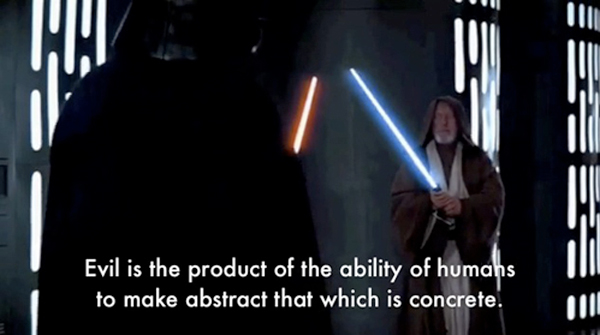
In philosophy we ponder existence and the meaning of creation. We ask questions like does life have meaning or is it a futile exercise of survival? Are we here to know our divine selves, to discover God or do we exist only to fulfill an evolutionary function through the law of gene preservation? Does life mean everything or nothing at all? I often ask myself these questions. Sometimes the questions are rhetorical as philosophy provides a response and Faith reassures me. Other times, especially when depression or apathy settles in the answers are less sure and doubt sets in.

In choosing recovery I made a decision to turn my life around. Sometimes I wonder if becoming sober and taking a spiritual view is not some sort of Jedi Mind trick on my self. That I’m not fooling myself. After all everything happens at the level of the mind. We can choose to believe whatever we want. The question of existential meaning in our lives can throw a spanner in the works. What is the meaning of life?

Psychology tells us the being able to modify our belief system from one perspective to another will in time change our outlook, our habits, character and ultimately our brain. The brain I had as a practicing alcoholic is not the brain I have now. Through nueroplasticity it has changed. Mediation and mindfulness are practices which have helped modify my cognitive and behavioral patterns. Indeed both are suggested by psychologists for that reason. Removing alcohol and working the steps also changes the brain. With a fresh set of eyes I see a world which is utterly different than what it was before.

“Even a thought, even a possibility, can shatter and transform us” – Friedreich Nietzsche

Red Pill, Blue Pill

In reality the world has not changed that much since I got sober only my perception of it has. Like a pilgrim on the road to Damascus I march along heading to a destination. Then on that road something happens. I stop look around me and ask the question that sometimes changes everything; “what’s the point“? Is there any point to any of this? Is life not just a futile exercise that ultimately means nothing and leads no where?

Nihilists premise that there is no existential meaning and all is for nothing. This idea suits many people but I have mixed feelings about it. Part of me embraces the idea that there is absolutely nothing I have to do or be. This means I can be whatever I want and not have to care.

I can take the blue pill and become a Nihilist. Hard reality crashes in. Virtue becomes entirely subjective; there is no right and wrong or good and bad about anything. Life is simply a choice between personal preferred and non preferred indifference. We can basically say “F&#k It” to anything, anyone and everything and sleep soundly at night.

On the other hand it is also bitter pill to swallow. Embracing a nihilist, albeit futile nature of existence view of the world throws the baby out with the bath water. It can leave us naked in a cold and barren world. The absence of philosophical and ethical tethers may feel good but apathy and depression doesn’t. Take the red pill and we jump in to the rabbit hole of endless possibility that could all be an illusion.

Life has no meaning the moment you lose the illusion of being eternal.” – Sartre

                  Source: Jean-Paul Sartre Existential Star Wars: Death Sartre

On a Mission

As a 12 Step Jedi I am supposed to champion virtues and uphold principles. There is supposed to be a point to everything. I know what’s right and wrong, good and bad. A philosophy based on both virtues and principles is to be practiced daily and lived. The Fictional Jedi took an oath to the code and dedicated their selves to that code no matter what the consequences. They lived by the code. A mission or cause could seem futile, even doomed to fail however the Jedi did their duty accepting whatever the outcomes.

Not all Jedi took that view. There were Jedi who chose to walk away and adopt a life that was more nihilistic in philosophy. These were the Gray Jedi. They had taken the proverbial blue pill.


The Gray Jedi

The “Gray Jedi” were not an order, there was no structure or organization behind them. These were Jedi who walked a solitary path free of any code but their own individual one. From a historical perspective they resembled the Ronin of feudal Japan. Unlike Ronin who were master-less Samurai and often mercenaries, the Gray Jedi were Jedi who had lost their Faith and had distanced themselves from the Jedi Order and Path.

Gray Jedi did not embrace the Dark Side, to do so would have made them Sith. Rather they walked a middle path between light and dark without embracing either. They were beholden neither to the Jedi or the Sith and were indifferent to both.

Master Jedi Qui-Gon Jinn was considered a Gray Jedi for his unorthodox ideas but was in fact a dedicated Jedi. In the old Republic there were true Gray Jedi like Jolee Bindo. Groups of Force users also arose that were essentially Gray Jedi. Quinlan Vos and Ahsoka Tano were never called Gray Jedi but both had lost faith with the Jedi. They survived as maverick rebels after the purge of the Jedi Order and destruction of the temple under Order 66. They saw the futility in their cause but with nothing else to do they carried on.


Losing my Religion

Luke Skywalker apparently suffers a loss of faith and becomes a Gray Jedi in the “Episode VIII: The Last Jedi”. Has he really become a Gray Jedi? Many seem to think that Luke has succumbed to an existential crisis. Luke is old and alone on Ahch-To. A self imposed exile with a lot of history. Despite his past he has never fallen to the anger and fear that swayed Anakin to the Dark Side. The futility of the struggle and a faith lost has made him a type of Nihilist. He finally said “F#%k It”. Sometimes I feel like Luke Skywalker, maybe it’s an age thing.

These days there is a real temptation to be a Gray Jedi. I’ve thought about it. I could also be apathetic and sober. I’m not sure how that would work though. Its not in my nature and apathy tends to go hand in hand with booze. Nihilism and apathy don’t always go hand in hand though but the latter is worth a mention because it figures prominently in the new type of nihilism emerging in society.


Generation Apathy

There is a growing trend for younger people to embrace a philosophy that claims a futility of existence and the absence of meaning. A type of hedonistic nihilism that dictates everything is going to hell so have the maximum amount of fun now with total disregard for the future. Mindless consumption is one of the symptoms, so is mindless sex and violence.

Society has become numb and dysfunctional. Religion is dying and spirituality is seen as less relevant. Nihilism, not even the true type as penned by Nietzsche, becomes the easier option to an apathetic and disenfranchised generation. The result is a general apathy and resignation that if nothing has any meaning so why should one pretend to care.

Social media posts, comments, likes and hastags have become the symbols of an uncomfortable apathy. We want to do something about all the wrongs we see on the internet, we feel anger, rage, inertia and finally apathy. A cognitive dissonance is continuously felt by people who feel they would do something if they could but won’t because it’s too hard. It’s in our face all the time. Saturation media and social isolation reinforces apathy and a sense of futility follows.

We are entering a post modern era. Truth and reality is now defined by the individual based on their own cultural, social and personal history as well as trending views that shift and polarize. The world is becoming over populated, culturally uniform, highly mobile, technologically connected and yet so very lonely and disconnected on a human level. Society has shifted from optimism based on scientific certainty and technology to one of pessimism based on uncertainty and anxiety. We are literally being conditioned not to care.

Everything has been figured out, except how to live.” – Sartre


 Snap out of it

Nihilism gets a bit of a bad rap for being the philosophy of Apathy, it isn’t. Nihilism simply states that nothing has any meaning, there is neither good nor bad. For many people this can be liberating. However we can depress ourselves when we ponder existentialism and start to question the meaning in our lives.

Right now I’m telling myself to snap out of my own sense of apathy. I need to get back on the road to Damascus and walk the Jedi Path again. I need to keep trudging the 12 Steps. Wallowing in self doubt and apathy won’t help. Perhaps a bit of media fasting will help. I can sit for five minutes and write a gratitude list. Try to keep busy and find a way to get outside of myself. There are a lot of things we can do when we start to question the very meaning of our lives.

Perhaps Nihilism provides a solution in part. Why be sad, apathetic or depressed about something that has no meaning?

But I still have to decide, do I take the red pill or do I take the blue?

Practice what you Preach

“Prove your words by your deeds.” – Seneca the Younger

The only worth a philosophy has is whether it can be applied in life. If our philosophy can be applied then we should practice what we preach. A practical philosophy means not only knowing what must be done but actually doing it. Without practice, a philosophy is conceptual and not a tool. We can sit in a university café (or online forum) for hours and debate the merits of one philosophy over another. One can bring forward the moral and ethical strong points of their chosen philosophical flavor but unless they have practiced it in real life then there is nothing much to say.

We go to a doctor or psychiatrist if we are feeling physically or mentally unwell. A psychologist or therapist is visited for counseling. Some of us visit a Priest, Rabbi or Spiritual Advisor to help us grapple with problems or questions. Who these days goes to a Philosopher for advice on how to live in accordance with a particular philosophy? We do not live in ancient Greece or Rome where we can engage in conversation with Socrates, Epicurus, Zeno, Seneca or Epictetus. We will not find Stoics, Skeptics or Ascetics to confer with and take away a formula for living.  If I were to walk in to the Philosophy Department of the local University and ask a professor for some sage advice on how to manage my affairs, handle cravings or deal with emotions he would probably not be able to offer anything practical.

The Philosophers

The ancients had words of advice on all these matters. Today we have many philosophies to choose from. The libraries are full or books written by the classic, renaissance, contemporary and modern philosophers. One can easily create an account on an online forum and engage in debate on Philosophy. The Stoics hold an annual conference and a “Stoic Week”*. The event draws people from around the world in an online experiment on living like a Stoic for a week. I participate in the event and continue to apply many of the practices as part of my own Jedi training throughout the year. You only get out of philosophy what you put in.

I consider myself a student of Jedi Philosophy. This means not only do I read widely on Jedi Philosophy but I broaden my knowledge in others as well. I participate in online forums and read posts to understand what other followers of the Jedi path think and how they live their lives.  The fiction is also there to draw inspiration from. Jedi philosophy is a recent phenomena and an evolving trend. The focus of Jedi Philosophy is similar in many ways to the ancient schools of philosophy. Students are encouraged to study and question but most of all to practice what they have learned every day. The Fictional Jedi was all about action and deeds, not words.

Deeds not Words

This emphasis on a practical philosophy for life agrees with recovery from addiction. The 12 Steps is also all about action. By accepting our disease and embracing certain principles in to our life we embark on a program of recovery that requires action. Reading books, speaking to people and attending meetings is not enough. Recovery occurs outside of that, in the day to day things that we do. We commit to mapping our faults and doing something about them. Addressing the past and seeking to make amends. Action includes daily maintenance of our practice through meditation, prayer and study. Service to others is also a form of direct action that helps us.

It is the same for any philosophy. One can say they are a Stoic but yet live like a Hedonist and allow their emotions and desires to govern their every decision. We are judged by our actions not our words. I can not say I am Jedi if I am rude and obnoxious to people, dishonest in my dealings and commit illegal acts like theft or physical assault no matter what the reason. Would I be able to stand up in a meeting and tell people I follow the 12 Steps and the principles of honesty and humility if in fact I continue to drink when I’m not there?

You are the Master

We can argue and debate about how one should act and what one must do to live a “Good Life” however unless we do these things none of that matters. It is only a rhetorical practice. No one is watching us all the time but ourselves. If there is a “God” and it resides within then the old scripture which tells us “God knows all that we do” is true. It may not be some deity outside of us looking down but our own inner conscience. If I question whether I am consistent with my personal philosophy of life usually checking in with my heart reveals the truth. We can fool ourselves in to thinking that we are something but deep down we know we are faking it. We can be dishonest with others, but to be dishonest to our self is far worse.

If I am unsure of how I must think, speak or act in any given situation there is usually no sage standing by. There are books and forums but usually we must decide on how to proceed from advice given in general terms. We must also filter what works for our unique circumstances and what doesn’t. I know what my principles and values are; I know which virtues to practice when faced with challenges. My philosophy for life gives me that tool kit and I decide how to use apply the tools.  There is a general rule of thumb when we get stuck or are caught with our pants down; we can react and possibly go against our principles or we can stick to the basic rule that Marcus Aurelius set him self every day:

If it is not right do not do it; if it is not true do not say it

Jump In

The practice of Kabbalah teaches students to just go out and practice; “first do it, then understand”. Don’t get lost in the detail or the semantics just pick up the tools and get to work. Trying to learn everything there is to know before practicing means never practicing. One must simply jump in. I did not wait to read the Big Book and the 12×12 and a myriad of other literature before I decided to abstain from alcohol, I did that first and then read the books.

At the moment I am trying to learn the guitar. A part of me thinks that I will be able to learn simply by reading the books, understanding theory and watching some you-tube videos. Unless I pick up a guitar and play I will never learn. Philosophy is no different. Even mistakes are useful, in fact making mistakes is essential.

Go out and practice being the person you want to be. There is no need to be a Philosopher or even to have a firm philosophy of life. Simply be the person you want to be and the rest will fall in to place. Practice what you Preach.

*http://modernstoicism.com/stoicon-stoicism-conference/

Miracles

Remember the Force will be with you always.” – Obi-Wan Kenobi

Losing my Religion

In the past I never believed in the idea of miracles. My religious instructors in school taught that miracles happened to those that deserved them. God rewarded the righteous but punished sinners. To me this sounded unfair. My mother had died for reasons I did not understand but she had been a devout Catholic.

I and my siblings were placed in an orphanage and eventually separated. Our Father was absent and probably drunk somewhere. Perhaps we were all sinners. I was never certain what we had done to deserve it. They spoke of miracles as if they were dispensed to the favored. Try as you might there was no reaching that state of perfection. In Star Wars I still found a glimmer of Hope and a spark of the Force but in time that light went out too.

For my ally is the Force, and a powerful ally it is.” – Yoda

Bottled Miracle

A few years ago I would have scoffed at the mention of miracles in any form. The metaphysical and the spiritual were for chumps. They were cop outs for people who were too afraid to throw their lot in with one deity or another.  The only spirit I needed was in a bottle. A miracle was to be still standing at the end of a big night. I pinned providence on fortune and luck. Both seemed scarcer than real miracles.

If there was a Divine source in the Universe I was not part of his plan. A part of me suspected that there might be something. This I put down to the residue of a religious upbringing and perhaps wishful thinking. As a child I had prayed for miracles they had never happened. My ideas were firmly planted in reason based on a faith in science and all the obstinate arrogance of a self proclaimed agnostic. I flipped the bird at religion but avoided the unrelenting dogma of new atheism in the fear that they might be wrong. I settled on something that was loosely “F##K It” and nihilist in view. Whatever justified my current lifestyle was fine.

Stealing Miracles

Religion and goodwill was to be taken advantage of. Miracles could be things we got out of people. My Father cheated the Salvation Army and other charitable organizations out of food stamps and money for years. It all ended up on booze or on horses. I watched and learned. Yes, one could make small miracles happen. Things could appear out of nothing. You just have to take them.

In Israel I even tried convincing a Rabbi that I wanted to convert on spiritual grounds only to be laughed at and told my true motive for conversion was to remain in Israel. He had a point, I did enjoy the laid back hedonistic lifestyle of booze, drugs and sex on a Kibbutz.

Few people really are (Atheist) , for that means blind faith in the strange proposition that this universe originated in a cipher and aimlessly rushes nowhere.” – Alcoholics Anonymous p10


The Miracle of Faith

Living in recovery has taught me that every day miracles do exist. I think I am a proof that miracles do happen, even to reformed dirt bags like me. If I could count the number of reasons why I should not be here writing this it would convince even the most ardent skeptic.

Miracles need not be resounding symbolic miracles of the basket of never ending bread and fish variety. I have never seen the blind or lame healed by divine faith alone. There has never been a man walk on water or float on air in my experience. I have some seen some very weird and inexplicable things in my time but nothing like that.

My recovery and change in life since becoming sober to me is however a type of miracle. I look in the mirror and I see a miracle. Look at the sky, the tree standing in the back yard, the person in front of me. They are all miracles. The guy at a meeting who was ready to take his own life and is now recovered and happy and helping others is a miracle. This very existence, an accident of chance or a played out destiny, is all part of the miracle of creation. Love is testament to the existence of miracles.

But I think the real miracle is not to walk either on water or in thin air, but to walk on earth. Every day we are engaged in a miracle which we don’t even recognize. A blue sky, white clouds, green leaves, the black curious eyes of a child, our own two eyes. All is a miracle.”-  Thich Nhat Hanh

Every Day Miracles

Every day is a witness to the miracle of life. We reside on a planet on the edge of a vast galaxy amidst billions of star systems and countless worlds. Our galaxy is one of billion of other galaxies within the known universe.

Cosmologists believe that an infinite number of universes exist. Mathematical evidence supports it. Dimensions and parallel universes that we are completely unaware of are before us. Time moves in a linear trajectory in our perception yet at the speed of light and quantum level becomes distorted and illogical.An electron can exist in two different places in the universe at the same time. Matter can move in time and space in ways that defy normal laws.

Our very physical existence is an illusion for we are essentially comprised of nothing. The atoms that make up all matter are nothing more than magnetic forces surrounding nuclei of mass which contains an incredible energy potential.  When I touch another I am touching empty space.  Yet we are connected to every other atom in the universe.

It’s (The Force) an energy field created by all living things. It surrounds us and penetrates us; it binds the galaxy together.” – Obi-Wan Kenobi

Those atoms form into complex relationships with others, more in number than the stars in the galaxy to form a human form. Within that form resides a consciousness able to define itself and peer to the stars and ponder its origin. Tell me that is not a miracle.

I know a lot of scientists, some are atheists but all agree in the incredible complexity and order of the universe. It appears in mathematical computations and scientific observation.  They also agree that as we reach beyond the frontiers of our knowledge we seem to be approaching a nexus. That point is where the spiritual and the scientific begin to reconcile and meet. If humanity can work towards the common good and avoid self destructing, we may reach that point and realize who we truly are and where we are going. We still know so little.

“We realize we know only a little. God will constantly disclose more to you and to us.” – Alcoholics Anonymous p. 164

The Miracle

I don’t know what God is or even if one exists, at least in the conventional sense. For years I had doubted the existence of any type of Higher Power that could not be empirically defined by science and quantified. I scoffed at the mention of the metaphysical or the spiritual. Now I believe that there is a Higher Power in my life. We each define our own Higher Power. There is no right or wrong. Within each of us resides a power that is greater than ourselves. I choose to call that Higher Power, the Force.  There is no need to define it or explain it; I simply accept that it is and that it is with me always.

“Close your eyes. Feel it. The light…it’s always been there. It will guide you.” – Maz Kanata

“If you knew who walks beside you on the way that you have chosen, fear would be impossible.” – ACIM


Time

You will know (the good from the bad) when you are calm, at peace. Passive. – Yoda


When you live to be 900 years old and have trained Jedi for 800 years like Yoda I suspect your perception of time would differ to a life form that lived a far shorter life span. The Galapagos Tortoise can live to over 150 years. Some have been recorded to live over 200 years. I wonder how passing time feels to a Tortoise. My guess is they don’t think about it much and simply live their lives one day at a time, one moment at a time.

Time is an illusion.” – Albert Einstein

To the rest of us, time is such a finite resource. These days’ people seem to be time deprived. In fact we are and it is not lost on a lot of corporations that take advantage of our lack by trying to sell us more time while exploiting the fact most of us don’t have the time to research options.

We are in fact rushing from one day to the next. Within what seems to be breath of existence we soon find our days have been utterly spent. Most people do not take the time to appreciate the moments let alone the time they have left.


The trouble is, you think you have time” – Guatama Buddha

The Illusion

What if it could be different? Do we need to devote all our attention and energy to a point in the future where happiness will be achieved? Our Ego is future focused. We work our lives away to be able to be debt free when we are too old to really enjoy life. We put in an ordinate amount of effort in to achieving some ideal at some point in the future.

Our dreams become preoccupied with a promotion or new career, new house, new car, better body and more money. When we arrive at these goals the happiness they promised in the past is not realized past the short term. We find ourselves arriving at one thing, finding satisfaction for a while before become restless and wanting more. The years and decades pass in some futile hedonistic pursuit of happiness.

It is not that we have so little time but that we lose so much. … The life we receive is not short but we make it so; we are not ill provided but use what we have wastefully.” – Seneca


Lost  Time

Life can be a string of meaningless acts of instant gratification and pleasure seeking. Ask any alcoholic why they drink. The fundamental reason is in order to fill some great emptiness in their lives. They seek fulfillment through the temporary sensation of pleasure that alcohol brings. Alcohol promises an illusion of happiness and transcendence to a higher plane. Of course we know the opposite is true. Booze distorts our perception and leads us down a path that leads to suffering and eventually spirals to a personal hell or worse.

One of the things that I became acutely aware of when I was drinking was the relentless march of time. I could feel the sands of time slipping through my fingers. It felt as if time was running out. I was careening to some unknown destination.

I would awake in the middle of the night still feeling the booze in my system. There was a creeping sense of terror. I could feel of the weight of some dark and terrible destiny on my shoulders. It felt like I was wrestling a Demon. The fear was tangible and at time I felt like I was sinking into some sort of purgatory, consumed by a darkness that had no limits and no escape.

Time stood out in harsh reality. I saw the remainder of my days set out before me like some twisted and dark path and I realized this was a slow death. At times I thought about suicide but I feared what came beyond death. I sometimes still feel the echo of that fear when I am tired and doubt clouds my mind.

They lose the day in expectation of the night, and the night in fear of the dawn.” – Seneca


“One Day at a Time”

There is a saying in AA that with enough sober time we get to have a choice whether we want to be an old timer or not. We have a simple choice; drink or don’t drink. Do or do not, there is no try. Through our choices we at least have some control in the present and in the future. That knowledge makes us realize that life happens in the Now, not at some time in the future.

We realize that there is no requirement other than a desire to stop drinking followed by a simple decision not to drink on a day by day basis. By simply not picking up, we decide to some extent how that day will turn out. The next day we do it again and again in the day after that. Life becomes a string of sober days and we find ourselves living “one day at a time”. The path is no longer a dark and twisted one. It has becomes a path filled with light and a bright future.

Time is a created thing. To say ‘I don’t have time,’ is like saying, ‘I don’t want to.” – Lao Tzu


Living Now

Living life “one day at a time” is the key to a “Good Life”. It is the path that leads to true happiness. We are more mindful of every passing moment. Our sobriety allows us to appreciate each day. The things that concerned us in the past become less of a worry.

We know that things will turn out just fine and even if at times life appears difficult. Fundamentally all is well and this too shall pass. We find within ourselves the need to help others and to share what we have learned.

Life becomes simpler, more meaningful and peaceful. I no longer wake up in the middle of the night gripped in some unspeakable terror. We lose the fear of growing old and dying. I know I belong to the Force and I will return to it one day so why should I be afraid?


Yesterday is gone. Tomorrow has not yet come. We have only today. Let us begin.” – Mother Teresa


The Old Timer

Yesterday I wrote about Growing Old. I mentioned a man, Li Ching-Yuen, who had lived 256 years. This man lived in China in the last century. All the aged who knew him, including very old men over 100 said that he had already been ancient when they were young children.

This man told that he had been trained by another who had lived to the age of 500. A type of Chinese Yoda, he had learned the secrets of the Force (Tao). Martial Arts, meditation, herbs and breathing exercises were part of his training.

Outside of the Old Testament there is no written story of people living to such an age. What was this man’s secret? According to a Journalist who met him it was based on a very simple philosophy of life:

  • Keep a quiet heart
  • Sit like a tortoise
  • Walk sprightly like a pigeon
  • Sleep like a dog

Whether  Li Ching-Yuen lived to 256 as was claimed or less is irrelevant. Li Ching-Yuen said that maintaining an inner calm and peace of mind, living in the moment were vital. Taking breathing exercises and being active and taking rest when needed were also secrets to his longevity. We all need these things to be healthy.

The Choice

In a world that is in hyper drive all the time and over obsessed with instant gratification and future reward these simple practices should be welcome. We all have within ourselves the ability to decide how we want to live inwardly and whether we let stress and the pressures of life build us up or break us down. Time in our experience only moves in one direction, our choice is how we use the time given us. Few of us will be able to cheat time but we can make the most of it.

We can all take a page from Li Ching-Yuen and like Yoda learn the true meaning of the words “Calm at Peace, Passive”.

Life is long, if you know how to use it.” – Seneca

Growing Old

When 900 years old you reach, look as good, you will not.” – Yoda

Recently I turned half a century. The milestone was not marked by any celebration and I asked that family and friends treat it as any other day. My Stoic attitude to turning 50 was to take the time to contemplate my life up until that point. I wanted to appreciate where I currently am in my life and ponder the future.

The inescapable fact

It is hard to escape the fact that time is not on our side. No one will live to be as old as Yoda. Those that do not die young will see their parents grow frail and eventually lose their health. Children bury their parents and grieve their passing as is the nature of things.

Our children grow up and eventually leave the nest seeking to start their own journey through life.  If we manage to dodge the many ailments and illnesses that seem to beset the middle aged we too also eventually grow frail. Our strength and agility slowly start to leave us. Sight grows dimmer, conversations are harder to follow and loud noises bother us more.

We watch as the world around us becomes more and more unfamiliar and we notice how young new parents look with their small children. Once upon a time not long ago we were that age too and had the same glow and vibrancy of youth.

One by one that that we knew leave us and start to dim in our memory. Soon our time comes.

Looking Back

I am now fifty years old. It feels strange to say it. I am a product of the 60’s and was born at a time when youth was rebelling against authority. The Vietnam War was being fought and the counter culture was in full swing not only in the States but around the world. They called it the “Love Generation” among other things. Some may actually remember that era (pun intended) and recall that it doesn’t seem that long ago. Yet it probably seems like an eternity.

They say I am Generation X. The very mention of the term brings back a lot of nostalgia. Which in itself is weird. I remember getting drunk and stoned a lot through the 90’s. The music was a mix of House music and then Grunge. An entire decade seems to have been lost in some sort of haze of booze and drugs or the fog of hangovers and brief recovery.Trainspotting and Kurt Cobain inspired the times.

There are the faded and yellowed photos of forgotten friends and fellow travelers in some remote and distant parts of the world. Everyone looks so young and happy. We are holding up bottles of beer and nursing cigarettes. There are bongs laying about.

We are wearing cut off Jeans, Nirvana and Led Zeppelin T-shirts and Thai Dye. Everyone has long hair and some of the guys have beards. Most of us are skinny, tattooed and tanned. There’s the promise of a good night and maybe love with a stranger. Life is a care free adventure, for a time there is no need to worry about the future. Youth seemed to be the promise that would last forever.

Never Lasts

Nothing lasts for ever and everything must end. Our travels, careers, friendships and close relationships, our very lives are all finite and impermanent. The party also had to end. I just never caught on like most and didn’t start growing up.

Booze tends to hold back the clock a little. Soon enough we are the middle aged person trying to keep up with people half our age. They are where we were 20 years ago and here we are still in the same place.

Ripped Off

Getting sober is a little like Rip Van Winkle waking up from his drunken slumber. The first thing Rip did on waking was go to his local Tavern and order an Ale. Looking around the Bar he noticed that the clientele was different. Some of the older people stared at him curiously. There was a young man that looked vaguely familiar to him.

Soon enough he was approached and it became revealed that he had vanished 20 years before and was now a much older version of himself. Rip Van Winkle had slept for 20 years, the result of a ghostly practical joke. The old fellows were his Friends and the young man his grown son. He learned that his wife had passed on. A bit relieved, Rip had another drink.

Waking Up

When we get sober the world appears different. Like Rip Van Winkle we realize we have been in some sort of slumber for years. Others have been moving on with their lives and in many ways we have been moving forward too but a large part of us has been rooted in the same spot. Once we have freed ourselves from the compulsion to drink our old haunts and old way of life no longer appeal. The chains slip off.

Sometimes I pass a bar or a night club and feel an urge to go inside, to resurrect a part of me that is now dead. I see the young people partying and having a great time, the music is blaring and the laughter fills the air. I feel a sense of nostalgia for the past but it soon passes and I remember who I am and most importantly when I am.

Old is a State of Mind

I do not consider myself old. In many ways I am excited about the coming years. After five years of sobriety I have learned so much about myself and recovery. I have barely touched the surface. Like Rip Van Winkle I see a chance to make a fresh start with every day. Age need not hold me back.

Indeed I can proudly say that I am fitter and stronger now than I was at 25. People say I look younger too, which I’ll take. There’s still a spring of youth in my step. I hope I’m wiser. There is the advantage of experience on my side. Wisdom acquired from a life of mistakes to draw from.

The Future

We can accept that the years will wear on us and eventually the tide of time will take us with it. Like Yoda I can face my ultimate destination with equanimity. My only concern is to live what Epictetus called the “Good Life” and whether I do or not is largely entirely up to me.

No one can know what the next day will bring. The future is always a mystery. With some certainty we can say that the sun will set tonight and rise in the morning to another day. Each day brings another chance to get things right, to learn and to grow and to use what we have learned. We can continue to look forward with hope and draw on our Faith that your best days are yet to come.

Recently I saw an article about a man who reportedly lived to 256. This man had been taught by another man who he claimed had lived for 500 years. The man is now dead but his story was documented early last century. The very old man had a secret for living to such an age which he shared…I’ll share it…..Tomorrow.

Tolerance

Remember, a Jedi fights only as a last resort. If you are forced to draw your lightsaber, you have already forfeited much of your advantage. A Jedi trusts the Force and at first seeks other ways to resolve problems: patience, logic, tolerance, attentive listening, negotiation, persuasion, calming techniques. But there are times when a Jedi must fight. – Luke Sywalker to Students

Higher Learning

Some time ago I was at a University during  its Open Day and I wandered from one tent stand to another. There were Philosophy and Political Groups to Religious and Sporting Clubs. A tent for sober and recovering students was parked next to a group calling itself “Party Hardy”. I enjoyed the appearance of harmony and tolerance on the campus. There were students wearing signs of religious affiliation and an Islamic students tent tended by young men in dish dash and prayer caps were serving Halal sausages to student wearing shorts and singlets.

I came across a tent stand that was occupied by a group that sit on the political spectrum well left of the middle. A large bearded guy with a Karl Marx T-shirt was standing next to a girl wearing a Hijab and a “Black Lives Matter” T-shirt. The guy saw me looking at the Posters decrying all the wrongs in the world from corporate power to American Imperialism and environmental destruction.

Seeing my attention he offered a newspaper and said “Hi”. On the cover was an article about the conflict in Syria. I paused there and he said something to the effect that “It was *expletive* terrible what is happening over there, Russia and Assad have started killing the Kurds”. My jaw dropped and I looked at him in amazement and asked “What? For real?”. This was a shock, did I miss something in the last 24 hours? The war in Syria moves and shifts at an incredible speed, alliances form and break up. The news is distorted and often fabricated. I spent a lot of time digesting news and sorting fact from fiction. If true, this was a serious development.

“Yeah Man *expletive* they dropped gas on the Kurds in Aleppo”, he said starting to get a little excited, “ *expletive* Russians, I *expletive* hate them”.

The penny dropped.

“Actually I said, that’s not right, last week there was a gas attack in Aleppo on the district held by the Kurds but the perpetrators were anti-Government Rebels holding East Aleppo, not Assad or the Russians”, I told him.

“That’s Bullshit” he replied, now looking at me with suspicion.

“No” I said “It was reported in many of the media outlets and by the Observatory for Human Right in Syria”

“What media?”, he asked “ *expletive* RT”?

“Yes, RT, Al Jazeera, Middle East eye and others”, I replied.

“RT and Fox man, that’s *expletive* Fake News, run by Putin and that stooge Trump”, he was getting a little red in the face, his voice was louder.

I made a comment that I knew people in Syria, western volunteers in the Kurdish militia, the YPG, and independent correspondents they had corroborated the story but the mainstream media had not picked it up.

At the mention of the YPG, the girl in the Hijab who had been standing to one side in silence, spoke up;

“The YPG?” she said “They are Terrorists, stealing land from Arabs, persecuting Muslims. They are worse than ISIS”, she pointed a finger at the sky.

“I’m sorry?” I asked rhetorically and replied;  “They have Arabs in their Forces, Christians too. They are socialists like you, don’t you support that”?

The bearded guy glared at me “They’re not Socialists Man, they’re puppets of Western Imperialism!”.

I was flabbergasted, these people are meant to be educated “But, the US supplies weapons to everyone in Syria fighting Assad or ISIL, even listed Terrorist groups”, I said and rattled off some names.

The lady’s  face grew darker as I spoke “The Kurds are racists and nationalists who oppress Arabs and Muslims on their own land!” she shouted “Anyone who supports them is an Islamophobe and a Racist”!

They both glared at  me like I was some sort of decayed trash. I was the enemy in their eyes. The symbol of what they hated. The conversation had ended. I gave him back his paper and moved on. I heard the girl say “Privileged White Asshole”  to her ginger haired white friend.

Tolerance is Being Heard

Once upon a time I had been politically active. I had considered myself a Socialist of the type that wanted to see the poor lifted up and conditions for blue collar workers improved. There had been the protests for the protection of Forests, nuclear disarmament and end of Apartheid in South Africa. We felt as if the causes were for everyone not just the few and our dreams were for a better future not a more divided one.

The protest movement was based on Love and Hope, not Fear and Anger. Now decades later I was in the same place I had walked in Protest as a naive activist complaining about intolerance and had just been called a “Privileged White Asshole” by a person who didn’t know me at all for expressing a view.  I thought about my childhood, the living in poor housing, the missed meals and forgotten Christmas’s. Going to school in threadbare clothes and worn out shoes. The years of struggling in alcoholism and the sting of shame at being broke all of the time. I felt like someone had kicked me in the groin. I never knew the privilege she was referring to.

How can someone judge  a person so blindly and so negatively when they don’t even know the person? We are taught that a person’s skin color, ethnicity and religion should not matter and that tolerance should be embraced. Yet at the same time the freedom of open dialogue and expression has been constrained to such a degree that to have an opinion is discouraged unless it is accepted as “politically correct”.  It occurred to me that there are people in the world on both extremes of the political spectrum who are intolerant of others beliefs and views. That not all people of Faith are tolerant of other Faiths. The world is more intolerant now than ever before and as a result people are lashing out.

The highest result of education is tolerance” – Helen Keller

Opinions are not Facts

We believe what we want to believe and when evidence appears that contradicts that “sacred cow” we either revise our view point or we throw the shutters down. I’ve been called Islamophobic, Homophobic, Xenophobic, Sexist and Misogynist and a Russophile in my time. I would reject those charges, except I am quite fond of Russia and Russian women in particular.

The point is that we may not agree on certain points of view or opinions but we can allow dialogue and discussion that is informed, considerate and causes no harm to others. If one is to learn and expand their knowledge the opinions of others must be considered and evaluated in an objective and impartial manner. Throwing the shutters down makes no sense just because we disagree with someone on a point of view.


Tribal Warfare

A study published in the American Journal of Preventative Medicine looked at the phenomenon of Social Media and the death of debate. The results found that social interaction is now stymied by the emergence of strong divisions along the lines of opinion on social issues and politics.

A sort if Tribalism has emerged where a person is automatically judged, accepted or rejected as a human being based on their opinions on specific issues such as race, global warming, religion, gender equality or politics. Non conformance with the accepted dogma will result in a tirade of hate comments and possible online harassment. In the real world it can get you harassed,  bashed or worse.

The New Intolerance

The phenomenon has spread to Universities and High Schools where lecturers and teachers insist on certain views that are consistent with their own and penalize or ostracize students who question them. I’m reminded of my childhood when any expressed doubt of “original sin” or the holy trinity was met with a torrent of shrieking and admonishment from the Sisters who taught us. If you did not conform you were defective and to be punished.

Recently Universities such as Berkley and  Middlebury College were the scenes of riots as students forced the cancellation of lectures by visiting controversial figures. These were not preachers of radical ideology and extremism but academics who hold a position that is counter to the current opinion and ideology. The Higher schools of Learning are being sabotaged and opinion silenced by dissent, righteous anger and the threat of violence.

Tolerance implies no lack of commitment to one’s beliefs. Rather it condemns the oppression or persecution of other” – John F Kennedy

Bartolerance

Intolerance is a trait that becomes an alcoholic. Being an obstinate and recalcitrant bunch we tend to get impatient with people that don’t agree with our views. We quickly right off people, places and things that do not concur with our distorted view of reality. Intolerance keeps the Ego strong and provides enough resentment and belligerency to keep us in active alcoholism.

Once upon a time I was a bar philosopher and boozy political commentator, the debates were lively, if not slurred, but as far as I was concerned the other person had nothing to say. Only my opinion mattered but that did not stop me from buying rounds all night to keep the conversation going. Anyone who drank with me was alright in my opinion regardless of their views. I had a type of Bartolerance on opinions.

Tolerance is the virtues of the man without convictions” – Gilbert K Chesterton

Keep an Open Mind

I love the phrases “take what you need and leave the rest” and “live and let live”, the first time I heard them in the context of tolerance was at a 12 Step Meeting early in my recovery. I had become dogmatic in my views about the program and was a bit of Big Book thumper. The printed words in the book Alcoholics Anonymous were gospel to be followed to the letter and without divergence rather than a set of recommendations and suggestions as the authors of the program had intended.

“Alcoholics Anonymous has no opinion on out-side issues; hence the A.A. name ought never be drawn into public controversy.” – Tradition 10, “12 Steps and 12 Traditions”.

Bill W and the other founders realized that in order to attract people to the program they needed to make it as palatable as possible for all irrespective of their religious, political or philosophical views or lack  there of. The Founders encouraged new comers to go out and try different things and to speak to psychologists, doctors and religious or spiritual advisors about their problems. The fellowship did not claim to have a cure but a program that if accepted as a way of life would bring a spiritual renewal that would remove the compulsion to drink.

In the program there are people of all religious denominations, political ideologies, atheists, agnostics, ages, races and background. Professionals sit side by side with shop floor workers. The rich sit with the poor. Everyone is in the same boat and opinions do not matter. All are accepted for who they truly are, a spiritual being having a human experience. A human being who wants to get sober. I have often wondered at how this is possible but it is and it could be like this everywhere. Opinions do not matter, people do. We can disagree but we can disagree agreeably.

Be Jedi, be tolerant and keep an open mind.

Power

“Don’t you see? We don’t have to run away anymore! I am more powerful than the Chancellor, I… I can overthrow him! And together, you and I can rule the galaxy! Make things the way we want them to be!” – Anakin Skywalker “Episode III: Revenge of the Sith”.

There is a saying that absolute power corrupts absolutely. Think of the number of Dictators in history who have ascended to absolute power through the power of the people and ultimately bought nothing but war, hardship and death. The most well known despots and dictators came from humble beginnings. Saddam Hussein was born to a family of shepherds from a Village near Tikrit. Hitler was born in a modest household in rural Austria and as a young man fought his Father constantly over his dreams to become an artist. Stalin lived in an impoverished household, his father an alcoholic cobbler.

In Star Wars, Anakin Skywalker was born in to slavery and remained in bondage until he was taken by Qui-Gon Jinn and bought to Coruscant to train as a Jedi. What marks each of these personalities is a burning passion to control and to shape not only their destiny but the destiny of those around them. At the root of that Passion was a deep seated Fear.

Power tends to corrupt, and absolute power corrupts absolutely.” – Lord Acton

Power Corrupts

People respond to power as they respond to fear. As a species we are social animals who gravitate to strong leaders who advance the needs of the group. Leaders are often selected for their qualities such as hard work, dedication, compassion and loyalty, their ability to derive the best out of the group.  Leaders also rise to power through cunning, subterfuge and ruthlessness, they promise people what they want and say the right things, they remove obstacles one by one. The manner in which some of the most vile Dictators ascended to power reflects their temperament and self will.

Power is always dangerous. Power attracts the worst and corrupts the best” – Edward Abbey

The tendency to put one’s own needs above others regardless of the consequences is the hallmark of a narcissist. Where the person is able to satisfy their needs at great expense to others and do so with impunity and without regard to that suffering is the markings of a psychopath. They do not know empathy, though they pretend to. The similarity between both personality types is that these individuals may appear outwardly normal and even successful in business, government, political or military service. They only care for themselves and their own desires though they may convince others, including loved one’s, of the opposite. They can be charming, funny, intelligent and sharp as a knife and yet within them resides something so compellingly dark and cold that it shudders the very soul. Give them absolute power and they will embrace it like a Bride taken to the grave.

Nearly all mean can stand adversity, but if you want to test a man’s character give him power” – Lincoln

The illusion of Control

Alcoholics have some things in common, in abuse priorities are skewed. Getting “tight” usually comes before most other affairs in order of priority and if it doesn’t we are usually working on the next opportunity. Where booze is considered we tend to have a complete lack of consideration for the needs of others. This can be painful to realize and we may deny it but then we remember the number of times we failed to make commitments to our families and friends when alcohol became involved. We spent our time and money on booze when it should have been for the family.

We tend to get hostile to those who suggest we might have a problem and when drunk we could resort to violence if the supply was cut off. When it seemed that others were trying to intervene or impede our drinking we became paranoid. We were certain people spoke bad things about us and plotted behind our backs, we became paranoid. We concealed our booze and drunk in hiding. Lying became second nature. Attempts were made to control people, place and things, we had to run the show and bend others to our will. When they failed to comply we became dark and sometimes we did and said things we later regretted.

Dance with the Devil and she will never let you go” – Sicilian Saying

Paranoia, narcissism bordering on psychopathic tendencies and rampant self obsession seems to describe some of the behaviors we exhibited. Sort of sounds a bit like a Dictator doesn’t it? I can imagine that our loved ones and Friends did not like that side of us and suffered as a result of our excesses.

Powerfully Recovered

Being sane and normal to the extent where we stop acting like a complete “POS” requires a fairly significant deflation of the Ego. All of the characters listed above went out true to character. Their Ego’s refused to accept the truth. Saddam was never humbled in his cell and was defiant to his last breath as he was hung by a cheering crowd of sectarian rivals. Hitler as mad as ever ordered his people to lay down their lives for him before he took the cowards way instead of defending Berlin. Choosing suicide Hitler took a capsule of cyanide and blew his brains out. Stalin died believing Russia loved him yet he was hated and feared to such an extent Khrushchev removed all effigies and statues of him.

In a symbol of a descent in to a person spiritual hell, Anakin burned in terrible agony on the lava flows of Mustafa as Obi-Wan looked on in pity and despair. As he burned and clung on to life, the hatred consumed him utterly. Anakin was finally redeemed by Luke in an act which symbolized the power of forgiveness and Love.

Those that recover after hitting “Rock Bottom” know the power of redemption, forgiveness and Love. That power saved over lives and restored us to sanity and health. Through forgiveness, humility, empathy, honesty and Love we become Powerfully Recovered.


The Power of Love

I was in South Africa in 1994 and witnessed one of the most extraordinary events in modern times. This was the first free and fair election in South Africa’s history. On April 27 the Nation voted in the first Black President in a country that had been staunchly Apartheid only four years before. I was there because I thought the country would “Balkanize” and erupt in to bloodshed, tribal fighting and war. I wanted to take photos and see what happened. There was no way war was not going to happen as “TIA-This is Africa”.

Many of the people I spoke to feared that Mandela would bring a Dictatorship to South Africa far worse than White Rule. Would he take his revenge for the extra-judicial murders, the brutal police and Army actions and his 27 year prison sentence? Would he confiscate property and return land to dispossessed tribes and kick out the whites? No one was sure what he would do, thousands of people left the country fearing the worst.

Civil War seemed certain. The tension and fear in South Africa was palpable and everyone braced for the coming storm though many dared to hope. Then the most amazing thing happened on April 28…absolutely nothing. That morning  the sun rose to a new flag and a new Democracy, there were no sirens or gun shots or smoke. In my hotel room I could hear birds singing and children laughing outside. As I lay on a bed in a cheap hotel room in downtown Durban, my throat parched and mind in torment from another hangover, I lit a cigarette and realized; this was the sound of Peace. I was a bit shocked and confused, not knowing what to do next.


Truth and Reconciliation

Mandela later opened the Truth and Reconciliation Commission and all of the crimes and atrocities that had been committed by all sides during the decades of Apartheid were laid bare. No one was thrown in prison and everyone was pardoned of their crimes. The only condition was complete and rigorous honesty. With the truth out, people were able to grieve, forgive and embrace and move on. Everyone had been a victim and the scars ran deep but there was a dream that the country could live as one, no longer divided along the lines of race and ethnicity.

This is why Mandela is seen as one of the greatest leaders in History. It was not a strong masculine presence or a commanding voice and great speeches that marked him as a great leader. It was his presence and his actions. Mandela had a calming effect on people and a kind word for all. Bafana had a deep love for his country, compassion for all its people and the ability to forgive and embrace those who had tortured and jailed him. Africa is full of tragic stories, South Africa was at last a shining beacon of hope in a troubled world.

Each of us is as intimately attached to the soil of this beautiful country as are the famous jacaranda trees of Pretoria and the mimosa trees of the bushveld – a rainbow nation at peace with itself and the world” – Nelson Mandela

Power can corrupt those that desire it above all else. Power can also be used for the good of all. Marcus Aurelius was a Stoic first and the Emperor of Rome second, he considered all people in and outside the Empire to be fellow citizens of the world. Power was a responsibility, not an entitlement or excuse for abuse.

Aurelius  believed that it was in the nature of all humans from the lowly peasant, to soldier to the Emperor to work together for the common good. That an Emperor should first serve the people and protect them. It is irony that his son Commodus would end up being one of the most despotic and violent Dictators since Nero and ultimately precipitate the beginning of the end of the Roman Empire.

Absolute power corrupts absolutely. Leaders like Mandela and Marcus Aurelius remind us that Power can also be based on Love.  One can still be powerful, caring  and humble at the same time.

The Hero

“I, I will be king
And you, you will be queen
Though nothing, will drive them away
We can beat them, just for one day
We can be heroes, just for one day” – Bowie

The Hero’s Journey

When George Lucas wrote Star Wars he based the story on the mythical Hero as described by Joseph Campbell. “The Hero with a Thousand Faces” describes the “Hero’s Journey”, a narrative monomyth which has existed since the dawn of story telling. The Monomyth follows the story of one who answers the call for adventure, the Hero archetype. Departing home the Hero encounters and overcomes the fear of the unknown and sometimes with a mentor learns the path to overcoming challenges and obstacles that lay ahead. Towards the middle of the story the Hero meets resistance and facing peril must overcome  an enemy or nemesis and finding strength and the help of others is able gain the prize.

The story continues and we think the Hero is safely home but encounters even greater challenges that bar the way. Unable to escape the Hero battles in a climactic struggle. Victorious at last  the Hero claims the final prize and discovers a revelation that restores the balance. The Hero is transformed and returns home or continues the journey.

The “Hero’s Journey” can be seen as a metaphor for life. We all face similar milestones in our personal Journey through Life. In recovery, we know the path quite well.

The Hero

People have always been inspired by the Hero. Legends and Myths are full of them. Since the Babylonian tale of Gilgamesh written in 18 century BC, the human story has included Odysseus, Hercules, David and Jason. Our contemporary fiction is full of them and include unlikely heroes like Harry Potter, Bilbo and Frodo Baggins and Luke Skywalker and Jyn, Rey and Finn. Each of the characters became swept up in events greater than themselves. They  became accidental heroes who went far beyond what they believed they could achieve for the greater good. Their stories followed the classic “Hero’s Journey” as described by Campbell. The Hero provides humanity with an example for others to follow. We carry our Heroes on shields and decorate them with awards and medals.

No Ordinary Hero

Sometimes the Heroes of the world are right in front of us but we don’t even recognize them. These are not like the Heroes in the Ancient or Modern Sagas. They have committed themselves when action was needed with no time to think or plan. The bystander who jumps in to perform CPR, the one who instinctively jumps in to a swollen river to rescue a drowning child and the person who races in to a burning building to pull out survivors are the ones we sometimes hear about in the news. They remind us that there are still people out there who are willing to risk their lives for others. We think their acts are exceptional and rare while in fact they are in most people. The instinctive need to help and to protect and preserve life. It’s in our DNA.

We often hail our sporting achievers as “heroes” yet what have they done other than win a title, medals or a trophy, usually for great monetary reward and fame? Society tends to overlook underpaid and overworked care givers like Paramedics, Nurses, public health care Doctors as well as Police Officers and Fire and Rescue for their daily heroic deeds. Volunteers who dedicate their time and money to helping the poor, looking after the environment or taking care of animals are rarely considered “Heroes”. Not many people would count School Teachers, Hospice Workers, Aid Workers and Volunteers as Heroes. Soldiers are treated as “Heroes” and lauded for their military feats in some wars and derided or condemned for fighting others.

The Classic Hero as described by Joseph Campbell is a rare gem and one that primarily exists in literature and movies. Real Hero’s are are actually everywhere.

The Accidental Hero

Luke Skywalker was a hero of my childhood and for me had all the ideal traits that made such. I could also relate to Luke Skywalker on a personal level as I had also suffered loss. Skywalker gave many kids a dream that they could reach for the skies and achieve incredible feats if they only believed. Not long ago someone pointed out that Luke was no Hero. Why I asked? Well, he had destroyed an artificial planet with many thousands of lives. This “atrocity” had not ended the war, in many ways it had extended it and the untold suffering it caused.

The Death Star was moments away from ending the Rebellion and the war but instead it was destroyed. The Empire suffered a crushing military defeat with the loss of important Admirals and the ultimate weapon of deterrence. The war raged across the galaxy for years after and so did the death and the destruction. My Friend kind of had a point.

My Friend also pointed out that Luke Skywalker was not only against the established rule of law and active in an illegal Rebellion but he was indoctrinated in to an ancient religion. This religious belief compelled him to destroy the Death Star and continued to drive him to carry out attacks in the war and eventually topple it. Does this not sound at least a little like a terrorist?

The Modern Hero Dilemma

I thought about the many recent conflicts I had become acquainted. In these wars I had taken sides. One side was “Right” and the other “Wrong”. More than once I had called people I knew “Heroes”. They had traveled to Syria to join the Kurds and fight ISIL, an extremist and brutal regime. While I believe my friends to be Freedom Fighters and “Heroes”, other people, many decent and intelligent, called them “Terrorists” or “Criminals”. It made me realize that the word “Hero” can be a little ambiguous at times. In fact not everyone can agree on what, let alone who, a Hero is.

Then  what is a Hero? How would we define it? Many Real World Jedi have their own definition of what a Hero is and they diverge as much as people in any other part of society. This is a Jedi Philosophy Blog so I will take the words of Joseph Campbell to help define what a Hero is here:

A hero is someone who has given his or her life to something bigger than oneself.“- Joseph Campbell

Then that would mean that anyone who has died for a cause that he or she considered bigger than themselves fits the definition of a Hero…Obviously this cause problems as it would firmly validate the phrase “one man’s freedom fighter is another man’s terrorist”. The cliché in fact contradicts itself as we know that no terrorist can be a Hero and no Hero can be a terrorist then neither can exist as they cancel each other out. To me a Friend in Syria is a Hero fighting for Freedom from tyranny, to many people in Turkey and  the Arab world he is a Terrorist as he happens to be fighting under a Kurdish Flag. Being a Hero can be complicated.

The Journey

As a recovering alcoholic I know that things never appear to be black and white. Every ideal and bias that we hold is a product of our Ego. The human psyche pushes many of us to embark on the “Heroes Journey”. In a perfect world there would be no need for Freedom Fighters or Terrorists. Heroes on the other hand, we need those angels like the Paramedics, Nurses, Cops and Soldiers who put others before themselves. The recovering Alcoholic in a 12 Step Meeting who comforts and consoles a newcomer who is at the end of his wits is a Hero. Each of us can through simple act of kindness and love in our daily lives also be Heroes.

“Saruman believes it is only great power that can hold evil in check, but that is not what I have found. I found it is the small everyday deeds of ordinary folk that keep the darkness at bay… small acts of kindness and love.” –  Gandalf “Lord of the Rings”

Marcus Aurelius admonishes us to stop “Waste no more time arguing about what a good man should be. Be one” There are five common traits found in a Hero. They are courage, selflessness, humility, patience and caring. These are the virtues which the Stoics like Aurelius found so important if one was to achieve the “good life”. They are also the virtues that a Jedi was expected to demonstrate consistently. The 12 Steps require all five virtues for recovery to be built on a solid foundation:

Courage

Courage is when a person does something in spite of their Fear.

Courage is resistance to fear, mastery of fear, not absence of fear” – Mark Twain.

Selflessness

Selflessness is doing something for others without expecting anything in return, indeed often with personal sacrifice.

selflessness is the only way for progress and prosperity” – The Bhagavad Gita

Humility

Humility is acting in a way that shows you respect yourself but never place yourself above others to look down.

Humility is not thinking less of yourself but thinking of yourself less” – CS Lewis


Patience

Patience is being able to accept that things to happen at their own pace even when we wished they wouldn’t. Good things do come to those that wait.

Patience is bitter but it’s fruit is sweet” – Aristotle


Caring

Caring is showing to others the kindness and concern that they deserve. Caring is in the little acts that we do every day.

Caring The simple act of caring is heroic” – Edward Albert


Can we be all of these things? Can we be the Hero that we are meant to be? We can be Heroes not in the big causes that we take up but in the simple every day acts of life.

Joy (Part 2)

The Happy Trap

In the book the “Happiness Trap” the author suggests that one of the greatest impediments to achieving a “good life” is the expectation that we must always be Happy. The mistake that we make is we confound “Joy” with “Happiness”. Once again, the two are different; one is an emotion, the other is a state of being. The book reveals that we often beguile ourselves by falling in to a “Happiness Trap”.

We have convinced ourselves that life is meaningless and defective unless we are “Happy” so we set ourselves up for stress and disappointment when we fail to achieve “Happiness”. We may be happy in the beginning but then the love of our life leaves for our best friend, we get passed over for that promotion at work, someone steals the car, the computer blows up taking all our work. World crashes in, our life is crushed and we think it’s over because we are now unhappy. Life is not over, life is both pleasure and pain and even this too shall pass. Don’t feel unhappy about being unhappy. Embrace the wonderful tapestry of emotions which make us human.

“The walls we build around us to keep sadness out also keeps out the joy” – Jim Rohn

The “Good Life”

Monks and Mystics do not give the impression of being a “Joyful” bunch, neither do Jedi. We imagine them to be serious and humourless and everything that resembles devout. Then we are surprised when we see religious leaders, devout people like the Dalai Lama, Thich Nhat Hanh, Desmond Tutu and even Pope Francis cracking a joke and being playful and funny. How could that be when the world is so full of misery, war and strife aren’t they supposed to be sombre and righteous? What is the secret?

St Francis of Assisi was also a spiritual leader who eschewed all the pomp and ceremony of the Church and chose a life of poverty, simplicity and service as Jesus of Nazareth had. Francis of Assisi is known as the patron saint of Ecology for his love of animals and defense of the Environment. At the Vatican Francis presented in front of the Pope in his simple habit and rags and instead of bowing and supplicating before the Pontiff he danced and sang in Joy to the complete shock of the watching hierarchy.

Francis preached in rapture about the beauty of nature and the wonder of the cosmos and the Joy of the Divine. Later Francis traveled to Egypt in the midst of the Crusades to broker peace and understanding with the Arab Caliphate. Instead of being killed or taken as a hostage he was honored by the Sultan and bestowed gifts. Francis returned home and preached that Christians and Muslims could learn from each other and co-exist peacefully as members of one big family. Francis took love, reconciliation, humility and respect with him and it was welcomed and embraced.

In our obsession with original sin we often forget original innocence”  – Pope Innocent III to Francis of Assisi

Saint Francis of Assisi was 46 when he died. The years of attempting to live as an ascetic in self imposed poverty and deprivation had caught up to him despite later admitting that a middle road of simplicity was the path to spiritual Joy. Francis suffered terribly during his death but his Joy never left him, the light that he held within him was strengthened by his strong spiritual faith and beyond. Jesus and Gautama Buddha died in the same way, as did Mother Teresa of Calcutta, Sri Chin Moy and Bill W, they all took their Joy with them. They transcended life.

The Stoics believed that one could be deprived of everything but keep their sense of Joy at living, even condemned to death a person could meet their fate with peace and Joy of knowing they had lived a “good life”. Nothing can take that away. I believe we take our Joy with us when we die.

“Joy is not in things, it is in us” – Wagner


End of Joy

Today’s Pope has attempted to emulate the historic Francis by trying to broker peace again in the Middle East. This has largely gone no where. The Pope also tried to encourage a global consensus on climate change and environmental destruction as well as address inequality and rampant consumerism, to no avail. Technology may have moved on, borders have been drawn and erased and Empires have risen and fallen but still the same problems remain.

There is a detachment, a disconnect between what we think is joy (pleasure) and what is true joy in our society and as result a deep discontent prevails. This disconnect has resulted in endless war, poverty, inequality, environmental degradation and global angst. Perhaps this is because we have become more distanced from nature than at any time in our history. Material and individual pursuits have replaced the spiritual and the collective. It is no longer “we” but “me”. Many people feel entitled to happiness but do not realize only they have the power  to make themselves happy, no one can do it for them. We need to stop living in a “feel good” society and start living in a “do good society”.

The Art of Joy

Joy in comprehending and looking is natures most beautiful gift” – Albert Einstein

Yoda and the Jedi were similar in many regards to the spiritual leaders who have genuinely tried to make a positive difference in the world. The Jedi were not void of Joy, in fact they were probably the most content sentient beings in the Galaxy but just didn’t show it much. The fictional Jedi had a deep and abiding connection to the Force, they knew they were part of a greater whole and they were at complete peace with who they were.

Death did not fear them as they knew ultimately they would return to the Force and become one with it. The Jedi lived austere and simple lives based around duty, virtue and discipline and as a result they knew Joy.  Jedi realized that the pursuit of happiness in the shallow way eventually led to grasping attachment, which lead to fear, anger and hatred and ultimately the Dark Side.

In the Clone Wars “Lost Missions” Yoda travels to a mysterious world that is intense with the Force. Yoda seeks the wisdom to be able to unite with the Force after death in with his living consciousness. That is, Yoda seeks enlightenment and immortality of consciousness. In this mysterious realm he encounters the spiritual manifestation of the five states of being that are said to survive death; anger, sadness, confusion, serenity and joy. Each of the forms guide Yoda through the trials he must face to achieve his goals.

Yoda survives the trials and having gained the wisdom he seeks, he returns to Coruscant. The Jedi Master has changed and in the place of the fear, doubt and regret which has plagued him through the Clone Wars, emerges serenity, peace and Joy. These three unified states define Yoda for the remainder of his life until he is able to leave behind his tired physical form and his consciousness unites with the Force.

Find a place inside where there’s joy, and the joy will burn out the pain.” – Joseph Campbell

Simple as ABC

Not many of us are in a position to change our lives to an extent necessary for significant spiritual, mental, emotional and physical improvement. We have lives, commitments, careers and families to attend to; responsibilities. Fewer want to completely leave their former lives and adopt a life as a Mystic or Monk in a monastery or retreat. We must all work out what works for us as an individual and try to maintain a balanced life that satisfies our personal needs with the needs of others.

Simple lifestyle changes can make a lot of difference, they do not need to be drastic. In sticking to them we find that the effort and time we put in to acquiring “Happiness” through the pursuit of shallow and meaningless pleasures and material possessions can be better served by going back to the basics, the “ABCs”.

A is for Act: always act in accordance with your identified values. Know what they are, they will guide you in every aspect of your life. Be spiritually, physically, socially and mentally active. This means take up a hobby or interest you enjoy, exercise within your limitations, socialize with like-minded people and build a network of friends.

B is for Belong: be part of something, join a club or community group or get more active if already involved.

C is for Commit: volunteer, engage in a cause, take up a course, accept a challenge.

It’s that simple.

only those who have learned the power of sincere and selfless contribution experience life’s deepest joy: fulfillment” – Tony Robbins