Joy (Part 1)

Happy is one of the many things I’m likely to be over the course of a day and certainly over the course of a lifetime. But I think if you have the expectation that you’re going to be happy throughout your life–more to the point, if you have a need to be comfortable all the time–well, among other things, you have the makings of a classic drug addict or alcoholic.”
― Carrie Fisher, Wishful Drinking

When most people think of a state of Joy they imagine a feeling of happiness. For example, seeing your Football team win the grand finals might give you a great deal of joy. We say we are “joyed” on hearing that our preferred political party has won the elections or we passed an exam and we claim joy when we win the cash jackpot. I see people on game shows absolutely in hysterics of “joy” on winning “a brand new car”. Is that Joy or just a transient state of happiness?

The Master Jedi Yoda is in many ways symbolic of an aged and wise old Buddhist Monk who resides in a mountain top temple somewhere where the air is thin in the Himalayas. You would find that these old Monks probably don’t have a lot to be “over joyed” about. After all, they spend their day in contemplation and meditation when not chanting or reading. Their lives are simple, ascetic and disciplined yet if you were ask them how they felt, they would respond that they feel “Joy”.

No Secret

Monastics and Mystics of all traditions and religions all claim the same thing, a deep and abiding sense of Joy. How is that? Where does it come from? In our Western and secular society can we come to the same sense of Joy without devoting to life in a temple or monastery? How can we feel joy if it’s not tied to food, sex, material possessions, winning and money? Is there some secret we don’t know about? I mean a secret, not that scam fad called the “Secret” where we simply claim whatever we want from the Universe be it a fast car, boats, money, hot partner and piles of money and it will just fall out of the sky along with a bucket of Joy because of the “Law of Attraction”.

There’s actually no “Secret”, Joy is  a natural state of being. If we focus on the breath and watch it we begin to sense that deep and abiding presence of joy within us. Call it whatever you want, it has many names but we feel it when we observe the breath and quieten our mind. Most people don’t even realize this and live in a false perception that only what is external can bring Joy when the real meaning of Joy resides within us all. That is a quantum leap for a lot of people to make when they have spent their lives seeking “Happiness” thinking it to be Joy.

Happiness does not depend on what you have or who you are; it solely relies on what you think” – Buddha

Happiness v Joy

Happiness is dependent on attaining something that is external to ourselves. The constant search for the “right” partner, career, home, car and lifestyle, that “right” combination of people, place, things and thoughts tied to some sort of insane expectation that it will remain so forever is the basis for happiness.

Happiness is a point in the future that is dependent on things that are largely out of our control. What may make us happy now may not rock our boat tomorrow. We invest so much energy on building the foundations for “Happiness” only to end up dissatisfied, disillusioned and falling out of love. All of these things are not necessary in themselves, we only think they are and we are fooled in to believing that the attainment of Joy is contingent on certain conditions.

In recovery we learn to recycle pain and despair in to Joy. Life is not so reliant on the attainment of  specific external conditions in order to be “happy”, we understand that Joy is a deeper sense of being not a fleeting emotion. Joy means that we can maintain a sense the “all is fundamentally well” even when things at the moment appear to be going the opposite. We know that “this too shall pass”, there is no pathological evasion of sadness but a healthy acknowledgement of our human emotions.

Having Joy is being able to be sad as well as happy, we do not feel that being sad or depressed means that there is something wrong with us because we are not perpetually Happy. We accept that life can be hard and painful and we understand that emotions like happiness and sadness are transient while true Joy is abiding and eternal.

You have no cause for anything but gratitude and joy” – Buddha

Fools Rush In

No! Unfortunate that you rushed to face him… that incomplete was your training. Not ready for the burden were you.” – Yoda

In “The Empire Strikes Back” Luke Skywalker departs Dagobah against the advice of his teacher and mentor Yoda. Luke is driven by the need to help his friends and seeks to confront the evil that is Darth Vader. At this time Luke is unaware of the truth about Darth Vader, he is untrained and mentally, physically, emotionally and spiritually unprepared for the challenge he has set himself. All of this matters not to Luke, like his father Anakin, he has a strong will and wants to prove himself. There is the compulsion in him to rush things and reach his goals before he is ready. In the Cloud City of Bespin Luke is lured in to a trap and meeting Darth Vader learns the terrible truth of his past before narrowly escaping. The revelation nearly destroys Luke.

Later in “The Return of the Jedi” Luke returns to Dagobah seeking to resume his training and finds there a frail Yoda, close to death. Luke broaches the subject of his Father and it is revealed that indeed Darth Vader is his Father, Anakin. Yoda then admonishes Luke that he was bound to fail in his confrontation with Vader, he was unprepared and not ready for the strong psychological and spiritual burden of knowing the truth and resisting the Dark Side. Yoda reminds Luke that sometimes in life we must realize we have much to learn and farther to go in our personal growth before we are ready to enter the next stage of our life.

The Stages of Life

Life happens in stages. We all know this. Babies are born and grow, Children bloom in to Teens and young Adults and then enter Adulthood. Eventually they find their chosen profession, find a partner and perhaps begin a family. Along the way they reach and surpass typical milestones in life mentally, emotionally, physically and spiritually. Eventually their own kids grow up and leave the nest and they enter in to the middle years of life possibly with Grandkid. There is retirement and contemplation and eventually the twilight years before succumbing to old age. That is how an “ideal” or “typical” life is meant to look, or so we are told.

The life experience of one person will differ to another. This can be due to a range of factors including age, gender, cultural upbringing and education. We may find ourselves getting impatient with other people or disagree with their views. Often times we have to consider that they may be at a stage in their life which we have passed or yet to reach. We have to make allowances for that. Remember that life is a progression, a journey in which we learn and grow over time often in stages. Sometimes we guide others, like our kids and sometimes we take advice from those with more life experience and wisdom than us.

It takes a long time to bring excellence to maturity.” – Publilius Syrus

Growing Up

Everyone ages and matures at a different rate. I have met 16 year old kids living in less developed countries who were more mature and grounded than some middle age professionals I have encountered in the corporate rate race. Maturity does not necessarily correlate  with age, position, address or size of pay check. Indeed as an active alcoholic I was emotionally and socially immature, a child in a man’s body. I stopped growing as a person once I started to rely on alcohol as a social stimulant and then a requirement. That did not stop me from being relatively functional but I needed booze to function. In sobriety I discovered that I lacked the basic tools to interact with people and handle situations normally. The crutch had been removed and I had to learn to stand on my own two feet with nothing more than a basic comprehension of a program for recovery and an even dimmer understanding of the concept of a ‘Higher Power”.

“Every difficulty in life presents us with an opportunity to turn inward and to invoke our own submerged inner resources. The trials we endure can and should introduce us to our strengths.” – Epictetus

I would not expect someone who has just hit rock bottom and looking for a way out of alcoholism to know everything there is to know about recovery. It takes time, patience, effort and a lot of faith to build the experience, knowledge, wisdom and skills required to attain “contented sobriety”. Deciding after 6 weeks of “white knuckled” abstinence that we are cured is deceiving one’s self. We can try to test that idea and perhaps get away with it but it is a huge gamble and one that rarely pays off in the long run. Believe me I tried.

The Long Curve

There are many things in life which present as a steep learning curve, parenting is one of them, bringing a baby home for the first time can seem daunting and even terrifying to new parents. There is all this stuff you have to do and know that no one tells you about and the books don’t even mention. Nothing prepares you for it. Babies don’t wait if they are hungry or need a diaper changed or run a fever for us to figure it out the first time.  By child number two you are a bit more settled and after that it’s a doddle. Now you are a veteran in child raising and you look at new parents going through the same steep learning curve and you smile knowingly. Parenting is stressful but most parents cope fine and learn a lot about themselves. Recovery is sort of the same, it is a learning curve but it’s not steep, its long and its all up hill.

We are what we repeatedly do. Excellence, then, is not an act, but a habit”. – Aristotle

Fools Rush In

One of the things I learned is that we cannot rush our recovery. There is no well defined point that can be reached where one declares “That’s it! I’m cured”. To take the view that a cure exists is to decide there might be short cuts and seek arrival at the desired destination of a subjective “normalcy” sooner. This is called the merry-go-round approach to life. We may change seats and try different ways of but we are still on the same ride and nothing changes.

What is “normal” anyway? Some would argue for alcoholics it is the ability to “take it or leave it” and to respond to life in an appropriate and proportionate manner. I am recovered but I will never be fully recovered and being honest would not even be able to define what “recovered” is. If I make it to the end of the day in a better condition than yesterday it’s a win.

The important thing to remember is that although we can claim the power to recover, we remain powerless over alcohol but we are never powerless to act. Many people might dispute this and claim a definitive cure but I err on the side of caution and set the cardinal rule as it applies to my addiction. I may be ready to take up a lot of challenges in life now and in the future but I will never be able to drink normally again. I won’t make the same mistake that Luke did and rush in to confront my addiction by feeding it.

Wise men say, Only Fools Rush in” – Elvis Presley

 Reaching Victory

Will I ever reach a stage in my life where I can claim victory? If recovery is a journey where the final destination is the end of life then it would be fair to say yes. If I can reach the end of life without having relapsed in to who I was before and can hopefully look back on a life “well lived” and accept death with equanimity, that is a victory in my book. There is no desire in me to declare a “cure” and return to drinking or arrive at a point that can be defined as “happily ever after“. I would not return to the illusion if I could, even if assured of being able to indulge without fear or anything worse than a hangover. That is a sane and a mature approach to something as insane as addiction. Live on life’s terms.

The final battle between Luke Skywalker and Darth Vader provides a lesson in victory. Surrendering control, accepting what is, embracing reality and letting go of what does not serve through action leads us there:

Luke Skywalker departs Dagobah and on the Planet Endor surrenders to Darth Vader. Taken to the Death Star II Luke is tempted to the Dark Side by Darth Sidious. The Emperor forces Luke to  battle Darth Vader and urges his to succumb to anger. Luke has grown and is able to resist falling to the Dark Side. His actions ultimately save his father and destroy the Dark Lord. Like Luke we must be willing to confront our own darker side not by use of force or resistance but by surrendering to what is, accepting who we are, embracing change and finally letting go. That is the path to victory. Luke had reached the end of his training and could now call himself a Jedi.

There is no “happily ever after” but Luke does find some closure, for now.

There must be a beginning of any great matter, but the continuing unto the end until it be thoroughly finished yields the true glory.”- Sir Frances Drake

Solo

There’s no mystical energy field that controls my destiny.” Han Solo “Episode IV: A New Hope”.

The Ultimate Lovable  Rogue

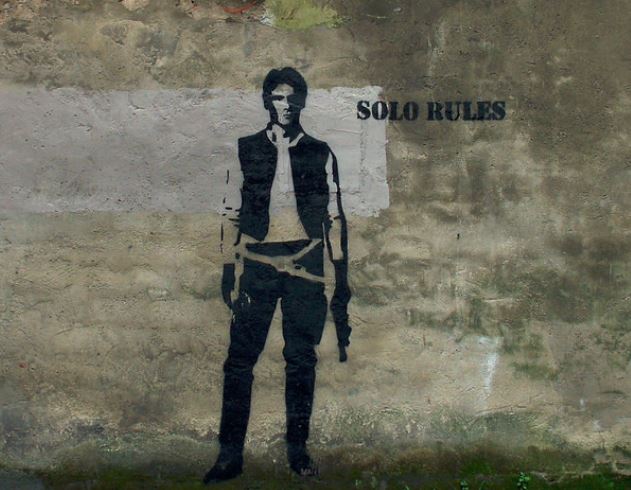
Han Solo was truly an enigma and if anything a stroke of genius by George Lucas. Solo was the real symbol of “The Hero” in the Star Wars saga, everyone else was just doing their duty. Solo did things because he thought “What the Heck, why not!”.  The name Solo described a personality that was ruggedly individual and self reliant, like a wild west cowboy. Rough around the edges but a heart of gold, someone you can depend on when “sh#t got real”, someone who is always there. Han is a character who is often overlooked as an example of an independent personality and a free thinker, he is the Lovable Rogue.

During the original trilogy we see Han Solo portrayed as a selfish and self centered mercenary become a man with some strong traditional values. Han Solo displays many qualities; he is loyal, reliable, resourceful, brave, patient, smart and compassionate. The image he puts out as being a rogue without scruples or allegiances is dismissed as he puts his own personal gain and safety at risk for others on numerous occasions. In an act of selflessness Han Solo forgives a friend who betrayed him to the Empire and got him carbon frozen. He risks his own life to save Luke Skywalker not once but twice.

That’s two you owe me, junior.” – Han Solo

The Romantic

Han Solo is a romantic and through the original trilogy we watch the on screen chemistry between the characters that continues off screen.

You have your moments. Not many of them, but you do have them.” – Princess Leia Organa “Episode V: The Empire Strikes Back”.

The romance that builds between Princess Leia and Han Solo reveals a character who is as sensitive and caring as he is spontaneous, obstinate and reckless. The polarity in character that exists between two strong minded individuals was what made the Leia-Solo romance so compelling and memorable.

Why, you stuck-up, half-witted, scruffy-looking nerf herder!” – Princess Leia Organa
Who’s scruffy-looking?” – Han Solo

The Rock

During the saga Han Solo also grows up and begins to challenge many of the prejudices and beliefs that he had. In “A New Hope” we see a character who is dismissive of the Force and inflexible in his views. Before the Battle of Yavin, Han Solo farewells Luke Skywalker and reveals a chink in his armor.

“May the Force be with you”Han Solo to Luke Skywalker on Yavin 4

Han Solo continues to defy expectations in “Episode VI: The Return of the Jedi” and wins the hand of Princess Leia. In “Episode VII: The Force Awakens” we learn he has had a son with Leia, Kylo Ren, who has fallen to the dark side. Seeking to return his son to Leia, Han Solo seeks out Kylo Ren and begs him to come home. The outcome is tragic, from Rogue Smuggler and Mercenary to loving Father Han Solo reveals his vulnerability to his insane son and is killed by him.

Han Solo reminds us that we are never rooted forever in one place. We change and our ideas and beliefs invariably evolve and change. Old ideas are cast aside and new ones are accepted before eventually being replaced as we learn from experience and gather more knowledge.

For all his obstinacy and strong will Han Solo was refreshingly open minded and often demonstrated Jedi-like virtues that were lacking in some actual Jedi. Han Solo was able to adapt quickly and fluidly and using judgement and life experience he could adjust his views without struggle. He was not encumbered with attachments despite his stated views and love of money but took a Stoic approach of keeping true to virtue and accepting what came his way. Even in his later years, Han Solo was an old dog who could easily be taught new tricks. In “The Force Awakens” Solo reveals to Rey his views on the Force and the Jedi:

I thought it was all a bunch of mumbo-jumbo, the crazy thing is that it’s true. All of it.” – Han Solo “Episode VII: The Force Awakens”

The Solo Effect

Being willing to drop our prejudices and adopt an open mind is critical for recovery. That willingness allows us to start to consider that we may have been misled or wrong and opens the way for us to make changes in our way of thinking and living. To be stubborn and inflexible in one’s life and accept only one world view or submit to dogma does not allow growth to happen. We must be willing to spread our roots out and go deep.

If you train an Oak to grow in a certain way, prune back the branches and restrict root growth it will conform to a desired shape and size that is unnatural. Place it in an open field and it will grow in to a grand old tree. That is what recovery is like, we must be willing to accept new things and new ideas and move with the flow of life, if we refuse to evolve we become stuck and we cannot move forward. Being willing is being Free to grow while at the same time letting dead wood fall off.

Be Like Han

Ask yourself today, where am I holding myself back? What is one thing I can do different today to free myself from that? Be a little like Han Solo, here are some quotes to help guide you:

“ Don’t tell me the odds” – Han Solo

Han Solo refused to let  C3PO’s grim calculations get in the way of doing what needed to get done. Don’t let others sabotage your truth: In life we meet naysayers and people who criticize the things we want to do. People tell us what we can and cannot achieve, often they are projecting their own set of self doubts on us. We can hear them out but we do not have to live our life to validate the opinions of others. If you believe in what you are doing that should be enough.

“I Love You” – Princess Leia

“I know” – Han Solo

This is a cliché but believe in yourself and never doubt that  you are worthy and deserving of love. Han Solo stuck to his convictions and he believed in his inherent abilities. Being a smuggler did not stop him from chasing his hearts desire and he got the girl.

Uh, everything’s under control. Situation normal.” – Han Solo

Even though things may not appear to be going the we way we want, we still have a choice on how to respond to it. We may not pull out a blaster and let a console have it but we can make decisions that are mindful and proactive rather than reactive. To paraphrase Epictetus, it is not the thing that upsets us but our reaction to it. As Ferdinand Foch once relayed before winning a crucial battle (The Marne Miracle) “My center is giving way, my right is retreating, situation excellent, I am attacking”. Sometimes it’s when things go to hell is when we are at our best.  Keep a cool head.

“I don’t know, Chewie… fly casual!” – Han Solo

Remember the slogan “Easy does It”. We can always do something without getting worked up about it. A boss of mine once said “busy” is subjective and “stress” is a choice, which was pertinent as he regularly worked 20 hours a day and never appeared tired or stressed, he was always calm and composed. We do it but we “do it easy”.

“Don’t get Cocky” – Han Solo

Han Solo could appear to be cocky and self assured but he had his head in the game and knew when to get serious. People that get over confident and cocky often stumble and then face a crisis of confidence. The Han Solo’s of the world play their best game and if they lose they brush themselves off and don’t let it get them down. They learn from mistakes. Han Solos are confident but never get cocky to the point of believing they are bullet proof. Being cocky in recovery is a red flag, we become so over confident of our ability to weather any storm under any conditions without ever worrying about slipping, until we do and then our world caves in. Han Solo rolled with it, he did not seem like a humble guy but in many ways he was.

Han Solo is an unlikely role model but he continues to inspire people in all walks of life. We can take a lot from the fictional character in our recovery.

Truths

Many of the truths that we cling to depend on our point of view.” – Obi-Wan Kenobi “Episode VI: Return of the Jedi”.

The Flatlanders

In the satirical novel Flatlanders by Edwin Abbot we learn how a Flatlander perceives reality in two dimensions and how he reacts to a third dimension when presented to him. To a Flatlander there is no height or depth to anything, everything exists in planar view. It is like imagining what it would be like to be a stick figure on a piece of paper going about its day, having breakfast, kissing the stick wife and stick kids good bye as it leaves to go to work on a two dimensional cart. To the Flatlanders the proposition of a third dimension was preposterous and dangerous. The reality of a Flatlander is hard to grasp as it would be hard for a fish to imagine a life on dry land.

Reality is merely an illusion, albeit a very persistent one” – Albert Einstein

Our World

What we hold true is largely derived from our cultural conditioning and our upbringing. We were not born with the ideas, attitudes and prejudices that we have. We acquired them along the way through experience and our interaction with society. Imagine the way a slum dweller in Calcutta views the world in comparison to an affluent person living in southern California. Even in Southern California the views of a Mexican itinerant farm hand on politics, gender, race and economic issues are likely going to differ widely to an affluent American living in Hollywood. The perceptions of the two social classes differ because their experience of reality is different.

The divisions that exist in the world based on cultural, ethnic, national, racial, gender and political lines are all illusionary. They exist as conditioned ideas in peoples minds. Alternatives do exist and no one has to believe anything, we all have a choice in what we believe and do not believe. Fundamentally people are the same. They want the same things, to live in peace and security, to raise their children and to provide for their needs.

No one is born “bad” and no one is intrinsically “evil”. No one is inherently “right” or wrong”. People may suffer mental illnesses or personality disorders that are expressed in maladaptive, sociopathic or psychotic behaviors. That does not make them bad or evil. Behavior may be perceived as “bad or evil”. There is no such thing as “Black and White” in a world that is millions of shades of gray.

Dogmas–religious, political, scientific–arise out of erroneous belief that thought can encapsulate reality or truth. Dogmas are collective conceptual prisons. And the strange thing is that people love their prison cells because they give them a sense of security and a false sense of “I know.” – Eckhart Tolle

Then what it True?

Reality Bites

Imagine how life must appear to the “hopeless” drug addict or alcoholic. Would it appear hopeful and optimistic? Or does it appear bleak and a constant struggle? Do issues that concern sober and clean people they know concern them? What is true to them, what appears real?

I recently listened to a radio interview with Chester Bennington the front man for Linkin Park. Chester committed suicide last week; he suffered depression and tried to resolve his battle with drugs and alcohol. In the interview Chester related how he perceived the world, the constant struggle he had with that perception while being aware that it is “all in his mind”. The tragedy is that Chester knew he had a problem and he articulated quite clearly what he needed to do to resolve his perception of the world and silence his mind.

Chester Bennington defined his truth and he articulated his reality. How we perceive that reality, the “world” he speaks of will differ from one person to the next. That is why when we hear stories in meetings we look to relate to the individual. Their story may be like many others but it is still unique, they are relating their personal reality. Many people outside of recovery would not be able to fathom it, they would be like Flatlanders trying to understate “Sphere World”. The interview with Chester Bennington can be seen here. I encourage that you watch it.

In active alcoholism our perception of reality is skewed. In the recent blog entries on Cognitive Dissonance and Motivational Needs we looked at how we struggle with reality and use maladaptive behaviours to facilitate our addiction. We explored some of the strategies we can use to bring ourselves back on course. Chester Bennington provides another example that how we perceive other people, even the rich and famous is often not the way they perceive themselves. To be human is to have vulnerabilities, weaknesses and fears. How we deal with our perpetual struggle for self actualization and transcendence is a battle that largely happens within our own minds.

We suffer more in imagination than in reality.” – Seneca

The Illusion and the Truth

On Tatooine Obi-Wan Kenobi had revealed to Luke Skywalker that Darth Vader had killed his father, Anakin. Later on Dagobah, Luke knows the truth about his father and asks the ethereal Obi-Wan Kenobi why he had lied to him. As far as Obi-Wan Kenobi was concerned, Anakin died even before they fought on Mustafa. By falling to the dark side Anakin no longer existed, there was only a pale shadow in the form of Darth Vader.

This was a truth to Obi-Wan Kenobi, it was how he perceived reality. Despite what Luke Skywalker thought, Obi-Wan Kenobi had never lied to him but he had not told him the entire story either. Anakin was a prisoner of his own perception of reality; being Darth Vader was an expression of a falsehood. Is that not a metaphor for a disease like alcoholism? A pathological denial of the truth.

Luke had to go out and face his own fears and seek his destiny. In doing so he redeemed himself and saved his Father. Luke offered Anakin an alternate reality; the Truth. Free from the illusion that had held him captive as Darth Vader, Anakin was able to overcome Darth Sidious and end his own suffering.

Obi-Wan Kenobi was wrong about Anakin, he was still alive. We are often wrong about others and especially ourselves. Our perception of the truth often deceives us but we choose not to challenge it.  We cling to our beliefs even when evidence is presented contrary to our view point. No one likes to admit that they are wrong but the first step in recovery is admission. In order to admit we must first look in the mirror and see things as they truly are. Then we must take Action.

From here on out, there’s just reality. I think that’s what maturity is: a stoic response to endless reality. But then, what do I know?” – Carrie Fisher

Needs

 Maslow’s Theory

The theory of motivational needs by Maslow states that there is a hierarchy which must be ascended like a ladder in order for an individual to achieve higher level needs. Simply stated, basic needs like food, water, shelter must be met first. The need for a safe and secure environment is followed by the need to be in healthy relationships, family and friends. The self worth of a person, their self esteem is also a need that must be met in order for them to have the confidence to achieve self actualization, the realization of one’s potential. Viktor Frankl suggested the highest need was to rise above the ego through self transcendence or enlightenment.

Alcoholism tends to skew our hierarchy of needs. The compulsion to drink will over ride basic needs such as nutritious food, sleep and basic health care. We often put our safety and security at risk and as well as our relationships. Being riddled with self pity, self hate, fear and anger our self esteem is near to non-existent or presents as a facade of arrogance and “big shotism”. Our primary need is satisfying our addiction. Everything else falls in to some fumbled order that rejects Maslow’s theory.

The Recovery Ladder

In recovery I’ve become acutely aware of my personal hierarchy of needs. Some times they seem selfish. I often ask myself if I’m putting my own needs before others. Is my recovery so important that the way I live my life is neglectful of others. Have I replaced one addiction for another in the form of a program of recovery? Sometimes I get confused as to why my need to self actualize and improve through the daily practices of meditation, study and physical exercise seems to be at odds with loved ones. Even with compromise there seems to be a tension. Am I missing something? What are my needs and how to I reconcile those with the needs of others? Am I being selfish and self centered?

In recovery we adopt a principle of “Live and Let Live” and “Let Go and Let God”. We surrender much of the control we once struggled to maintain. Trying to control people, places, things and circumstance put as at odds with the flow of life and when we didn’t get our way we drunk to get even. We grew resentful and bitter that the world did not conform itself to our expectations. Then in recovery we focus on self improvement and are left feeling guilty asking if self improvement is self indulgence.

The Me Reality

Look around you. Everyone is doing what they want. Not only that they are making their cake, eating it and posting the entire event on Face Book or Instagram. Right now there is a global phenomenon of highly visible but false self actualization going on. People have become so fixated in gaining acceptance and validation that they follow fads or what ever is trending that day and fish for likes for everything from the mundane to the insane.

Society is obsessed with instant gratification and entitlement. The effort required to achieve real self esteem and self actualization is sabotaged by a pervasive attitude of easy access and discouragement. People want the gains but they are not prepared to work for it and are confused when life does not grant them their wishes. In the perpetual search for approval and validation they will accept ‘Likes” on Social Media as a surrogate. From the moment kids were given “participation trophies” for showing up and the words “winning and losing” were banned from school age competition we created a society that screams “me, me and me”.

The Other Side

It seems people are too busy judging each other or trying to validate themselves on social media. They have forgotten the motivating factor behind their actions or it has been reduced to “Likes”. Does it really matter what other people think? Do we really need to be so obsessed with widespread approval?

What happens on the other side of the street is not as important as what happens on our side. Sobriety is largely contingent on how we feel about ourselves and how we think moment to moment. If our words and actions are consistent with our personal values then we are on steady ground. When we allow conflicting needs and expectations to confuse our own primary goal of staying sober and we start to fall off course.

Jedi Needs

The needs of a Fictional Jedi were very clear and very simple. Basic needs were met without fuss or fanfare. Jedi would eat when hungry, drink when thirsty, sleep when tired and seek shelter from the elements when required. They dressed to suit the environmental conditions they expected to operate in. The safety and security of others was more commonly placed before their own. Jedi were still cautious when required and did not take unnecessary risks. With the exception of Anakin and one or two others, the Jedi were mindfully daring but not foolhardy or reckless. Decades of rigorous training meant that actions and reactions were drilled in to them.

The Jedi formed close bonds with their own and with other sentient beings. While grasping attachment to individuals was not allowed they were encouraged to form positive and productive relationships with all life forms. The Jedi knew that all life is interconnected and belongs to the Force and they identified strongly to that non-dualistic belief.

Jedi naturally had self esteem and self confidence that comes with achieving excellence. The Jedi Order was a meritocracy and Jedi were promoted from Padawan to Knight and finally to Master and Council Member when they demonstrated they were ready. There were no free lunches and no short cuts.

Self actualization was the outcome of Jedi training. The harsh conditions under which they trained and operated, the supportive nature of the Jedi Order and the focus on personal development and self improvement through training, mentorship and experience produced individuals who were mentally, physically, emotionally  and spiritually highly evolved. The Jedi could also reach transcendence and unite with the Force.

Realities and Needs

The goal of “world betterment through self betterment” in Jedi Philosophy strongly advocates self actualization. Real World Jedi are expected to demonstrate virtues and qualities in all their affairs which are consistent with the Jedi Code. This means that real world Jedi, like the fictional Jedi we take inspiration from, have the following qualities:

  • they are tolerant and accepting of others. Being easy on others but hard on themselves;
  • they are humble without being self deprecating or lacking self esteem;
  • they seek meaningful and rewarding relationships based on mutual respect for each other needs and opinions;
  • take a realistic and objective view of life that understands that good and bad things happen;
  • understand that hard work and effort is needed to get results;
  • accept that sometimes we do not get what we want;
  • simplify and take a minimalist approach to possessions and wants;
  • can be self reliant and not have to depend on others for needs including approval and validation;
  • show creativity through expression or through action;
  • take an active interest in the environment and community, thinking global, acting local;
  • Jedi seek practical and sane solutions to problems as they arise.

When I look at this list I see many of the virtues and principles that underpin the 12 Steps. Being a 12-Stepper and a Jedi is not that much different. We know who we are and we know what our needs are and we can define them. Our hierarchy of needs are re-established. We take care of ourselves and care for others. We build meaningful and deep relationships. Our self esteem improves over time and we remain humble. With spiritual growth we  go beyond single spiritual experiences and start to realize transcendence.

We seem different to other people, because we are; we are survivors. Having values and principles that keep us sober is not a drawback, it is a great asset in these times of instant gratification and discouragement. Of all the people out there, it is those that have survived the trials of life be it trauma, tragedy, addiction or mental illness that truly understand the climb up the ladder of the hierarchy of needs. The blessing is we can use that to pass a hand down and help others up.

Cognitive Dissonance (Part II)

Part II: Overcoming Cognitive Dissonance

Several days ago a Friend of mine who runs a martial arts business posted a poignant piece on the psychology and the consequences of quitting. My Friend was not talking about quitting a destructive habit such as compulsive drinking, gambling or drugs but on the perennial challenge of seeing new students quit within two weeks of signing up.

The truth is that quitting is a hell of a lot easier than sticking if the activity is difficult but beneficial. This is why the majority of candidates on the BUDS program for the Navy SEALS bomb out in the first 48 hours. They figure to themselves “this is harder than I thought”, “why don’t I quit now and save me further pain”. The training Staff are experts in picking up doubt and mental weaknesses and pounce at any sign of it. They actively encourage the candidates to quit, to ring the bell and throw in the towel. The SEALS want men who are mentally and emotionally resilient and who stay the course. Physical toughness is only about 30-40% of BUDS. Mental and emotional strength is the key to getting through.

The opposite is true for things that are seemingly bad for us or contrary to our cause. These things seem extremely hard to quit particularly if the habit is addictive or reinforced in any way. Drinking and taking drugs for example is extremely difficult to quit despite the obvious harm they do us. If anyone had asked me which would be easier, quitting smoking and drinking or getting through something like BUDS I would have said BUDS. Most of us want to quit but cannot find the mental, emotional and spiritual resilience to last the distance. We relapse when we try on will power alone.

The Serial Quitter

I can sympathize with my Friend for a couple of reasons. Firstly, I was a serial quitter and know all about it. I have taken up a number of activities and made up excuses and quit. Cross Fit, Kickboxing, Gym memberships and even martial arts. Those were sporting and recreational pursuits. I also gave up on jobs, career paths, studies, relationships, sobriety, life….The excuses were less than adequate but it all boiled down to two things; fear of commitment and intractability.

For some reason I have always feared commitment. Most things I ever did I did so because I felt under pressure in some way. When it came to applying effort under my own steam voluntarily and without obligation I would find something else to do and eventually give it away. This was because it was easier to default to the softer option. I also imagined that I was not good enough, or I looked stupid or having stumbled and failed once I decided what was the point. In this state a person suffers a crisis of self confidence and fails to commit. Alcohol or drugs provides a convenient remedy as it dulls our sense of accountability and reassures us that we are better than we actually are.

Intractability

Intractability is being obstinate and difficult to manage. Alcoholics generally have a rebellious streak and we are rooted in our flawed belief system. Self discipline and the ability to commit are concomitant in sticking with a program of recovery, martial arts or BUDS selection. Alcoholism on the other hand tends to throw self discipline to the wind as soon as the first drink is ingested.

The mind set is reinforced in Alcoholics to reject opinions or information that is contrary to our world view. We may be brilliant when we want to be but the second something tips us over or someone gets in our way, we throw the whole lot in, stamp our feet and quit. We proclaim that “they don’t know that they are talking about”. Our only Master is Booze, she is the one we ultimately take orders from.

In a Dissonant World

In today’s society we are increasingly left feeling isolated, in conflict and under tension. Technology dominates every aspect of our lives. Morality seems to have fallen by the way-side or at least replaced by a type of righteous political correctness which stifles discourse and counter views. Society has become polarized. People are feeling less connected within the community and despite the prevalence of social media are feeling increasingly marginalized. This environment has given rise to an unprecedented level of cognitive dissonance in society. Fortunately there are ways to break free from it:

1. Question your views.

In a critical and objective manner dissect your belief system. Challenges assumptions and question everything. Ask if you are not holding on to beliefs that are flawed. Do you have your hand in a Monkey Trap?

The Monkey Trap requires a monkey to place it hand inside a box with a small opening large enough for a hand to fit through but not a balled fist. The Monkey will reach for the treat inside the box and clutching on to it is unable to free itself. If it could only let go of the treat is would be free. This is how some of us hold on to our ideas and prejudices. We convince ourselves of a reality that does not exist and we hold ourselves to that despite evidence to the contrary. Seek evidence and reject what does not hold true.

In the case of Martial Arts, the belief that “I can’t do this” is self perpetuated by quitting. If we break down a problem in to smaller portions and focus on achieving milestones the challenge does not seem so momentous. With a change of perception we entertain the possibility we can achieve. As they say in AA, “take it one day at a time”, the miracle may happen tomorrow.

2. Get out of your Comfort Zone.

Trying new things is absolutely essential to growing as a human being. Have you ever observed a child? A two year old will explore everywhere it can, pick things up and make a mess. She is learning at a phenomenal rate about her world and place in it. We never stop learning and the best way to keep growing as a person is to expose ourselves to new things that are outside of our comfort zone.

The British SAS has advice for candidates on its selection course; “embrace the suck”.  They reason that the cold, hunger, fatigue, uncertainty and exhaustion are guaranteed so might as well embrace it. The course is undertaken in a manner where the candidates never know what is happening or going to happen. If one approaches the course with a “Can Do” attitude rather than a fearful one they are already half way through.  It is a mind-game. With practice and perseverance we arrive at confidence that we can do this. Start off with a “Can Do” attitude.

We all define our “own impossible”. If our mind can imagine something then its possible that it can be done. It is about convincing ourselves that we can take the first step and put one foot in front of the other. Eventually we get to our destination if we keep going.

3. Simplify

One of the reasons we stall in recovery or in any other challenge is because we often over complicate it. Most challenges look complicated because we frame it that way in our mind and the easiest option is to abandon the idea. We also seem to use the word “But” to excess. For example, “I want to stop drinking BUT I’ll lose my Friends” or “I would go to Train BUT [insert excuse here]”. We often complain that people get in our way when most of the time it is our own selves that sabotage our efforts.

In every decision there is an opportunity cost. Only the person can decide if it is worth it? Would I rather be sober or get wasted with Friend? Is sitting at home on Face Book instead of attending training a worthwhile use of my time? All we need to do is ask ourselves what is more important; there is no need to complicate. Decide and choose that. If there are obstacles that complicate your decisions either work around them or manage them out. Yes, this includes “Friends” that pull you away from your goals.

4. Keep you eye on the Goal

Visualize the person you want to be. See yourself standing there in a year’s time having accomplished the goals that you set. Keep that image in your mind and if required draw up a battle plan to get there. In that plan set a strategy, determine the resources you will need and set achievable milestones along the way. Keep the Plan fluid and adaptive so it can to survive the unforeseen. Just because you have a plan does not mean that life will come along and try to upset things.

If you stick to your (rough) plan and keep track of progress you will see improvement over time. For the last 6 months I have stuck with a fitness regime which has resulted in significant gains. Daily application and commitment to the program has been the formula. At first I made excuses not to workout but reminded myself of the reasons I was doing it.

Self Discipline and effort are two Jedi traits that are required to keep on track in any endeavor including sustained recovery. Remember that all you really control is the effort that you put in. An Olympian can train as hard as humanly possible but that does not guarantee a Gold Medal at the Games. If we achieve our goals in the time and manner we set, great, if not we should still recognize the effort we put in.

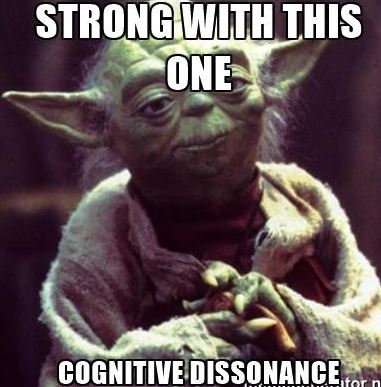
Luke Skywalker suffered Cognitive Dissonance on Dagobah while was being trained by Yoda. The effort and time needed to get through the trials and the study to becoming a Jedi were obviously more than he was willing to invest at that time. The need to be Jedi conflicted with his need to “be elsewhere”. Luke Skywalker lacked patience and the tension forced him to leave his training early and confront Darth Vader before he was ready…Which brings me to the last point:

5. Is it Worth It?

My Friend has taught Martial Arts for 40 years and has been in countless confrontations which he managed to defuse or resolve using skills drawn from decades of training. On quitting he asks his students one basic question to help with their Cognitive Dissonance; he asks “is it worth it?” The price of not learning Martial Arts might mean that they do not acquire the skill set and discipline to confront an attacker trying to kill or rape them. The price of learning Martial Arts will mean years of dedication, hard work, pain and sacrifice.

When we put it that way it often seems more stark. In the context of life and death it does not get much more clear. Some people need more proof than others.

Do I pick up a drink and most likely relapse in to active alcoholism or do I work the program?

Every one of us must decide what we value and act in accordance with that. No one can force us, we must decide ourselves.

Cognitive Dissonance

The Elephant in the Room

One of the things that hold people back from making meaningful and lasting change is cognitive dissonance. Its like ignoring the Elephant in the Room. Take a smoker for example or an alcoholic. Both are aware that their habits are harmful. The smoker is cognitive of the fact that smoking causes lung cancer and the alcoholic is aware that drinking is doing her harm; however both will persist in the habit. We won’t talk about it. Why?

The theory of cognitive dissonance states that individuals do not like their actions to conflict with their attitudes. The divergence results in tension called cognitive dissonance. People will find ways to reduce the dissonance by adjusting their behavior, seeking information that contradicts their beliefs or deciding that on the balance of things the habit is worth it. Life is too short so why give up the pleasure of smoking, drinking or drugs.

From the time I started drinking I knew that it was doing me harm. I had seen the effects and I knew that based on a family history of alcoholism I was at high risk of becoming alcoholic. I experienced a high degree of cognitive dissonance expressed as regret and remorse at my drinking.

Making Excuses

Over the years I tried to control my drinking and stop many times without luck. I was trying to cure the cognitive dissonance just not the drinking. If I could drink without all the bad stuff then it would be OK.

Often it’s a close call that gets us to re-evaluate. Fear of death seems to spike dissonance. After almost getting run over by a Semi Trailer I decided to quit drinking. The actual driver approached me in a bar and said that he would have run me over had he not recognized me. Pulling to the side had almost caused him to leave the road. His suggestion was that I quit drinking or probably die. Three things happened:

  1. I quit deciding that I had run out of chances and would lose my life if I continued. This lasted for a day and I decided to substitute starting with light beer and then moving to half measures before deciding that taste is more important than dissonance.
  2. After a while I decided that as long as I stayed off the roads drunk I should be okay. I reassured myself that despite some close calls in the past the odds were still on my side. Anecdotal evidence strongly suggested this. Cheers!
  3. There was still doubt (dissonance) and alcoholic obstinacy kicked in to compensate. Drinking with a head full of doubt is no fun, so more drink is required. We all know that once a drink is taken a chemical reaction takes place in the brain which over rides logic. I would quickly convince myself that I was harming no one by drinking. Alcohol made life pleasurable and was therefore worth the small risks it carried. I could always quit whenever I wanted to, just not now.

Almost being flattened by a Semi Trailer had me readjust my attitudes in a manner that reduced my cognitive dissonance but allowed me to continue to drink unabated.

The Bleeding Obvious

Being alcoholic creates a new type of cognitive dissonance, the tension that exists when we refrain from drinking and our body and mind is addicted to it. The thought of refraining from alcohol is bad enough let alone imagining a life time without it. In addition we can easily justify what we do to ourselves and others. We become trapped in a paradigm that can shift to ignorance and conflict with others. The opinions of others no longer matters. We become resentful of those that disagree with us or worse, try to change us. Addiction at its worst will see people do anything to protect it.

Alcohol may be man’s worst enemy, but the bible says love your enemy.” – Frank Sinatra

Nothing less than a fundamental change in mindset bought on by a psychic shift bought on by a spiritual experience worked for me.

Storm Trooper Finn’s Dilemma

Star Wars has many examples of inner and outer conflict. Luke Skywalker was a case study in cognitive dissonance as was his father Anakin. They both suffered from a lack of rationality bought on by conflicting ideals and motives. Anakin wanted to be a Jedi but at the same time he wanted to control people, places and things. Anakin wanted to bring order to the Force in his own fashion and overcome mortality. The tension eventually pushed him to the Dark Side. Luke on the other hand was conflicted as to his role. Is he a moisture farmer or a rebel, does he fight his father or side with him? The story of Luke is a classic “Heroes Journey”.

We see the same type of dissonance in the “The Force Awakens”, Storm Trooper Finn has a crisis of conscience. Being a merciless killer for the Empire does not gel with him and he deserts his post to join the Rebellion. Soldiers who decide to desert on grounds of morality don’t usually do it at the spur of the moment as Finn suggests. There is usually months if not years of dissonance. What they do does not agree with who they are. Something eventually has to give and they leave.

“I’m not Resistance, I’m not a hero, I’m a stormtrooper. Like all of them, I was taken from a family I’ll never know. And raised to do one thing. But my first battle, I made a choice. I wasn’t gonna kill for them. So I ran.” – Storm Trooper Finn “Episode VII: The Force Awakens”

Source: www.knowyourmeme.com

Stay or Go?

I know a few deserters and there is one thing in common with all of them. All quit because they were deeply dissatisfied and disillusioned. Some were close to suicide. They could not stay no matter how hard they tried. They were still torn at leaving their comrades behind. All of them to this day regret their decision. Cognitive dissonance can suck. No matter what we decide to do, it is going to hurt and there will be regrets even if it was the right thing to do.

So how does one deal with Cognitive Dissonance? No one likes to feel lousy about what they are doing especially when they know that it is the right thing to do. A person can be sober and still have Cognitive Dissonance. Despite being dry they may have adopted habits or attitudes that are maladaptive or destructive. The “Dry Drunk” can eventually relapse.

Emotional sobriety is about accepting ourselves and embracing who we are. It is about rejecting denial and being willing to see things differently. Often this means rejecting our previously deeply held prejudices and attitudes. Recovery means being willing to explore new ideas and adapt to life readily instead of being attached to one way or another.  When we know who we are, commit to values and act in accordance with them in a spirit of non-attachment we are unlikely to suffer dissonance.

Be gentle with yourself, Let Go of what does not serve, especially limiting prejudices and adopt an attitude of “Live and Let Live”.

Part II: Overcoming Cognitive Dissonance

Speak

The ability to speak does not make you intelligent” – Qui-Gon Jinn “Episode 1: The Phantom Menace”

Jar Jar Binks was one of the most annoying characters created by George Lucas in the prequels. Many Star Wars fans cringe at the Gungan buffoon and derided the prequels for introducing him. Jar Jar Binks is actually like a lot of people we meet and not all of them act that way when they are drunk though they may at times sound like him. They are usually drawing a lot of attention their way and speaking a lot without actually saying anything useful.

How often do we kick ourselves after we have said something better left unsaid. We often catch ourselves too late. It would be better to think before speaking. There are also times when we wish we had said something but we didn’t. Not speaking up also seems at times as bad as saying the wrong things at the wrong times.

Silence

Silence is a virtue or so we are told. The teachers in my catholic school would remind us often that children are seen and not heard. Silence was imposed and voicing an opinion was discouraged. I have discovered that often the greatest wisdom comes from the mouth of a child. Plain truth belies innocence. One should always speak their truth quietly and clearly. Listen to your kids or Grand kids often.

Learning when to speak and when to keep silence is an art. We all want to be heard. Sometimes we are not given the chance. The loudest and most assertive speakers generally get the floor. Passive and quiet people are usually not heard above the din.

The Power of Quiet

I’ve usually found the loud, gregarious and boorish types who insist on being heard above others have the least to say. The ability to speak does not always imply intelligence. In our society it seems that the most vocal and the loudest get the most airplay time. There is nothing wrong with that as it is a sign of open discourse which keeps Democracy alive. This is true as long as others are not silenced and forgotten. The loud and arrogant have a right to be heard but so do the quiet and humble.

Usually the quiet types are the ones we need to listen to. Their silence might not hide ignorance but a reluctance to speak. They may also know that saving your voice for when it’s required is often the best approach. You see them in the back of the room at meetings. They are also the silent person at work and the quiet achiever in the team. When they speak up I usually listen intently. The quiet ones usually have something I often lack; diplomacy, wisdom and tact.

“[The Spartans] conceal their wisdom, and pretend to be blockheads, so that they may seem to be superior only because of their prowess in battle … This is how you may know that I am speaking the truth and that the Spartans are the best educated in philosophy and speaking: if you talk to any ordinary Spartan, he seems to be stupid, but eventually, like an expert marksman, he shoots in some brief remark that proves you to be only a child”. – Plato

Who would’ve thought the Spartans were the silent types? Many guys I met who were Special Forces Operators were quiet and unassuming but also sharp as a tack. The mark of a true warrior. A lot of people mistake being quiet for being weak, often a big mistake! The guys you met in a Bar who were loud and telling war stories were usually from rear units or had never served. Big mouths are usually compensating for some deficiency.

Speak Up!

Francis Bacon said that “silence is the virtue of fools”; this is true for those who remain silent when they should have spoken up.  Never remain silent when to do so would be an injustice. If we speak up and learn that despite what is apparent we are wrong then we can make amends. It is too late after something wrong happens that we could have otherwise prevented by raising our voice. It often stuns me when I learn that an accident has happened in the workplace and I hear someone say “I could see that was going to happen”. My first question is “Why didn’t you say anything?” . We all have a responsibility to speak up when it is required.

The fictional Jedi by nature were not gregarious, they were assertive and they did speak up when it was required. They did however speak mindfully; they measured their approach and considered their words particularly over delicate matters. The Jedi used tact and diplomacy. Words were not wasted. They said a lot in few words.

Listen Up!

We have two ears and one mouth, so we should listen more than we say.” –Zeno of Citium

Being a good listener is also a virtue. When we speak we are moving from the known to the known. Listening takes us from the unknown to the known, we learn something. Then in order to communicate effectively one must actively listen and respond being mindful of what we say and how we say it. Language is only partially verbal; body language, facial expressions, eye contact, hand motions, tone and the most subtle cues often communicate more than words. By listening actively we are communicating.

Women in particular are expert at picking cues and know when a guy is not listening. So for the sake of serenity, Listen!

A good listener is not only popular everywhere, but after a while he knows something.” –Wilson Mizner

Meesa throw it all together

Knowing how to listen and when to speak and when to hold tongue is an exercise in self discipline and mindfulness. As an alcoholic I often feel compelled to allow my emotions to drive my tongue. It takes real presence of mind to catch myself. A speech injected with anger or resentment may get an impact but it is one we learn to regret later. Angry or yelling we don’t hear anything, not even ourselves making a mess of things. In recovery we learn that anger and resentment does not serve us. To throw anger at others through our words makes us feel worse not better.

“”First learn the meaning of what you say, and then speak.” – Epictetus

Jar Jar Binks eventually made it to the Galactic Senate and despite his clumsiness with words and actions still proved to be a worthy ally up until the fall of the Republic. The fact that he became a politician seems a parody of our own society where sometimes the politician with the biggest mouth ends up in the highest office. We should still be willing to give those people the benefit of the doubt when they say things that are less than intelligent. After all many of us said things that we wish we hadn’t and expected the same courtesy from others.

Geographical Cure

Well, if there’s a bright center to the universe, you’re on the planet that it’s farthest from.” – Luke Skywalker “Episode IV: A New Hope”

The Geographical Cure is the idea that enters in to our mind suggesting that the grass is always greener on the other side. We decide that if we were to change our location and find a place where we are meant to be we will find peace and happiness. All our problems will be resolved by moving to another town, city, state or country.

Psychologists have shown that the Geographical Cure works some of the time for some people but in most cases the benefit is temporary. The flip side of the Geographical Cure is the fact that when moving from one place to another we are moving. No matter where I go, there I will find me. So if I want real change in my life, moving to a Greek Island or French Provence might sound ideal but it is unlikely to change my mind or behaviors. Believe me I tried.

Gypsy Life

As a kid we moved around a lot. You could’ve called us Gypsies. I won’t list them here but before I completed the 7th Grade I had moved from one end of the country to the other and attended over 20 different schools. The adventure was only interrupted briefly by social services that placed me and my siblings in to State Care for a period of time. The reason for the constant moving was a parent who was alcoholic and was a strong believer in the Geographical Cure. If anyone proved that the Geographical Cure does not work, it was my Father.

Like Father I also moved around a lot mostly to get away from myself. Getting to somewhere new, becoming familiar with the people and the culture, making new friends was intoxicating at first. The problem of course was when I got to any of the numerous places I chose as “ideal” I soon ran in to myself. Then the real “intoxication” would begin and so would the dramas and the scandal that ensued.

It was then only a matter of time before I made my excuses and tried somewhere else. I’m probably the only person who ever tried to make Aliyah to Israel and got told “no longer welcome and don’t come back” by my exasperated hosts. Its a bad sign when an entire country doesn’t want you.

Book of Stamps

After many years of wandering the globe I did not have any major epiphanies, there were no resounding breakthroughs and I was alcoholic. Traveling and drinking tend to go hand in glove.

On return home I could boast an International bar crawl that had taken me to over 30 countries in 5 continents. I  even had a collection of glass coastere from Pubs around the world. There was no Geographical Cure for me, just a steady decline and then a plunge to “Rock Bottom”. I became recovered in the same town I had left 27 years earlier to join the Army and “see the world”.

I still get the urge for Geographical Cure. Perhaps in my sobriety I realize that despite the many stamps in tattered passports and the grainy photos of me getting plastered with unrecognizable people in exotic locations, I didn’t really get to see the world or experience life as it is meant to be. The travel bug remains. I wonder if I had the chance again would I do it differently or would I see the world through beer goggles once more.

At times when people and life pisses me off  I imagine a small cottage on a Greek Island or in the foot hills of the Pyrenees. Fishing, hiking, writing and reading and mostly being alone. Then I remember people will probably annoy me there too and life will still be difficult. Running away from our problems does not solve them, it often makes them worse.

Life is what happens to you while you’re busy making other plans.” 
— John Lennon

Home is where you make it

Moving town, city, state or country may or may not make us happier. It really depends on your definition of happiness. There are places I longed for and when I got there I was disappointed. Was it the place or me? A place does not care, it exists in spite of us. We stand there in the same body and look upon it with the same set of eyes. When we bring ourselves, happiness can be found on a paradise like Naboo or on a hell hole like Tatooine.  Happiness comes from within and so does change.

So when Luke Skywalker looked at the twin suns setting on Tatooine and dreamed of getting off world to join the Rebellion he was looking for a Geographical Cure.  Life as a moisture farmer on an outer rim planet that no one cares about can be pretty glum. Luke was like his father wanting adventure, travel and purpose. He was impatient and wanted to run away. The reality of life as a fugitive, rebel and Jedi soon caught up with him.

Forty years later we find Luke as an old man on the “Jedi idyllic” setting of Ahch-To, on a rock in the middle of a cold and wind swept oceanic planet. I wonder if Luke had found his Geographic Cure. I guess we will find out in “Episode VIII: The Last Jedi”.

And remember, no matter where you go, there you are.” – Confucius

Bigger Fish

There is always a bigger fish” – Qui-Gon Jinn “Episode 1: The Phantom Menace”

In the scene in “Episode I: The Phantom Menace”, Qui-Gon Jinn and Ob-Wan Kenobi are pursued by an underwater creature. Jar Jar Binks, is in fits of terror while the Jedi seem unconcerned by the looming menace. They seem more annoyed at the bumbling Gungan  they are stuck with. As the reptilian carnivore closes in it is ambushed by some vast underwater behemoth that rises from the deep and swiftly devoured. Qui-Gon Jinn remarks nonchalantly “Well, there is always a bigger fish”. It’s a forgettable scene but it’s a memorable quote and is one I use often in applying my philosophy for life.

Fact 1: No matter how big and tough someone thinks he is there is always some one out there who will better him.

Never think for a moment that you are invincible and that if you hold the title for world champion someone is not going to come along one day and knock you off your pedestal and claim the crown. It need not be a title or the claim to being the best at anything, even becoming over confident can eventually lead to cocky self-assuredness, arrogance and finally complacency. This would be a fatal mistake. For someone in recovery they are all red flags which can ultimately lead to relapse. Humility as a virtue is vital to sustained recovery.

It was pride that changed angels into devils; it is humility that makes men as angels.” – Saint Augustine

Fight Smart

The only wars that are truly won are those that were resolved before a shot was fired. I personally would not invite my addiction outside for a fight. I might win the first round but eventually pound for pound it will mop the floor with my face.  So I won’t dance with the Devil.

By fighting we leave ourselves open to being beaten, especially if we lead by the chin by being arrogant. Regardless of how recovered I think I am I know that the best way to win a fight is not to be there in the first place. I avoid situations that lead me in to trouble, I recognize the red flags as they appear and if required I have a tool bag of spiritual and mental skills I can use when needed. I fight smart.

The art of living is more like wrestling than dancing, in so far as it stands ready against the accidental and the unforeseen, and is not apt to fall.” Marcus Aurelius

It is better to treat life like a wrestling match than a dance or in the case of an alcoholic, a bout of bare knuckle brawling. Trying to fight life through brute force only wears us out and half the time you are beating yourself. Fools think they can dance through life. Realists realize that life is more like wrestling. Life sweeps us up, knocks us down and tries to pin us. We manage to break the hold and flip things over getting the upper hand until the next time we are thrown off balance. The trick is to be prepared mentally and physically for the things that tip us over.


Fact 2: No matter how big or bad a problem seems to be it could always be worse.

The next time something annoys you or you are faced with a vexing problem ask yourself “could this be any worse”? The truth is of course it could be. Things can always be worse than they are. Take a moment to collect your thoughts. Look around you and notice the things that are going right in your life. Realize that the world is still there, society still functions, the sun will rise in the morning to another day. What ever is bothering you now will pass.

Sobriety does not give us immunity from pain but it does give us the opportunity to respond to the vicissitudes of life in a sane and appropriate manner.

Man is disturbed not by things, but by the views he takes of them.” – Epictetus

Gratitude is a powerful force in your life and so is the ability to perceive and prepare for the “worst case scenario”. Negative visualization is one practice I use often to readjust my perception of “problems”. When I think about how bad some people have it I am reminded of how lucky I am. Things could always be worse.

Imagine the Worst

Negative visualization was used by the Stoics. Seneca reminds us that we should remember that our life can end at any moment and we should appreciate life to the full. Epictetus advises that when we kiss our children good night we should remember that it may be the last kiss. Children can be taken away. All things are transitory and impermanent and fate can change in an instant so we are reminded to savor every moment we spend with our loved ones.

Society compels us to live hedonistic lives, the book “The Secret” teaches us to use positive visualization to get the things we want, stating that the University will provide riches and opportunities if we simply claim them. Negative visualization teaches us to want what we have and appreciate more what we get.

The trouble with trying to get the Universe to give us things through positive visualization is we get really annoyed when it doesn’t fall out of the sky in to our lap. Worse it fosters a culture of entitlement and a ride on the hedonistic treadmill, we get what we want and then soon growing tired of it we want more and more.

Negative visualization teaches us not to take anything for granted especially our sobriety.

Prepare for the worst, hope for the best” – Unknown

Jonah and the Big Fish

Let’s use Jonah as an example in keeping with the giant fish theme. Jonah was sent on a mission by God which he didn’t want to accept because it was “too hard” or it didn’t agree with his plans. Too bad Jonah these things pick you. Displeased, God tossed Jonah about on an angry sea before the reluctant prophet was thrown over board by his terrified companions. Jonah was then swallowed by a behemoth and held for three days in the innards before being unceremoniously spewed up on the beach of ancient Israel for good measure. Then it’s a long walk to Nineveh where he has to deliver the news that the entire city is about to be destroyed by divine wrath which is certain to make him as popular as a bacon sandwich at a Bar Mitzvah.

Things do turn out well though; Jonah gets his second wind and gets the population of Nineveh to repent sparing them from annihilation. Having done a great job he gets a whole chapter dedicated to him in the Bible and almost everyone has heard the story.

Jonah should have just had faith to being with and done what he was told in the first place and cut all the fuss, he should have gone straight to Nineveh. Instead of being a sour puss Jonah should have taken a leaf from the Athenians and used negative visualization to harden up for the worst case scenario and then worked for the best outcome. The flip side of course is that his reticence taught the rest of us an important lesson about accountability and duty.


Fact 3: The biggest and best that you think you can achieve might be wrong. You can always do better if you want. There is always “bigger fish to fry”.

We define our own “impossible”. If we say we can’t do something we are probably right, if we say we can we are probably right. Recovery has taught me that I can achieve more than I gave myself credit for. I never imagined I would be three months sober let alone 5 years. If I can do it so can anyone else.

The idiom does not only apply to recovery but in all other aspects of my life as well. Whether it is setting goals at work, in training or in my personal life I set the bar a little higher. I try to work in a zone of Eustress.

Good Stress, Bad Stress

Under stress is where we are not challenged. We are simply coasting along and usually accepting mediocre as good enough. If we put in average effort we are going to end up with average results but more usually none at all.

Half measures availed us nothing” – Big Book p59.

Distress is the opposite, we are at the limit of our physical, mental, emotional or spiritual capacity and sometimes beyond. Performance starts to fall apart and effort is non-sustainable. In early recovery I went in to hyper mode and over loaded myself. This of course led to distress and almost a relapse. “Easy does it” means to do it but do it easy, which of course means Eustress!

Eustress is the zone in between under-stress and distress. It is the zone of optimal performance where we are challenged but within our capacity and we can improve over time.

Set Goals

I work towards self improvement. In physical training for example the only way to make gains is to increase the load or the reps a little every time, introducing new exercises also helps, mixing it up. Sticking to the same routine will work for a while but soon you will simply plateau out and get bored and you won’t make gains.

When setting goals that push you, allow yourself to recover and then ratchet it up a bit more. If you plateau, back off a bit and then hit it again. Without rushing but with a slow and steady pace you will see improvement. New opportunities and bigger goals come in to view and the next thing you know you are doing things you thought were impossible a few weeks or months prior. Put the effort in and see the results. Nothing worthwhile is gained without hard work. Fortune does not fall out of the sky as promised in “The Secret”.

This formula works for training, learning a language, overcoming fears, dealing with anxiety and depression and almost anything else where the goal is gradual improvement over time. Always speak to a professional health advisor before starting a new program.

Oh and if you fish you will be very familiar that there is no such thing as “the biggest fish” only the “biggest catch of the day”. There is always tomorrow and if you hook Jar Jar Binks, throw him back in.